Amrut Fusion

Amrut Cask Strength

Image from The Whisky Exchange

Back in the day when I was still very susceptible to any trend in whisky that came along, combined with professional reviews like Murray’s, Broom’s, Valentin’s and many others I thought I had found a new whisky Valhalla with Amrut. I had a cask strength version very early in my whisky ‘career’, and since then bought a bottle of the first peated version, one of the first Blackadder Amruts and a bottle of the first batch of Fusion.

Since then I’ve become a bit more picky when it comes to Amrut, partly because they increased their prices significantly (€ 45 for their first Cask Strenght, now new releases are around € 80 I think). Understandable, but they’ve priced themselves out of the ‘ah, what the heck’ range by doing so.

They’ve earned the right to do it with bottles like the Two Continents and the Intermediate Sherry Matured, but in some cases I find it over the top (think Amrut 100, and Kadhambam).

Sniff:
Amrut Fusion at Master of MaltComplex swith a lot of different corners of the spectrum. Fruity, spicy, woody. There’s an almost savoury spiciness to it, with hints of peach skins, nectarine. It’s a bit thin though, but that might be because the bottle has been open for years.

Sip:
Somewhat thin again, but it feels oxidized instead of thinly flavoured. Scorched wood with a similar fruitiness as on the nose. I get curry spices too that make me think of garam masala, but I’m not overly familiar with that…

Swallow:
The finish has a bit more oomph to it than I expected and is a bit more alive. The complexity is very prominent here.

Before, I really, really liked this bottle and have recommended it to many people. Especially since it came at about € 35 at first. Now, after it has been open for some 4 years it’s not as good. I feel it’s oxidized quite badly which is a shame. Not truly rateable because of that.

Still, based on recollection, this is a very fine dram, and still very affordable. You just have to finish the bottle in 2 years or so. Can’t really see the problem in that!

Amrut Fusion, 50%, OB, available at € 50 at Master of Malt.

Posted in - News and Announcements | Leave a comment

2 Single Cask Springbanks

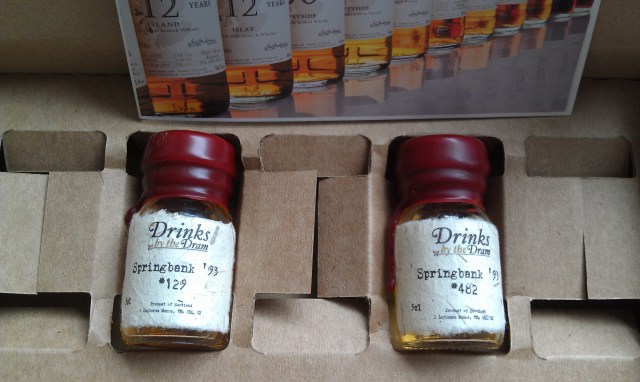
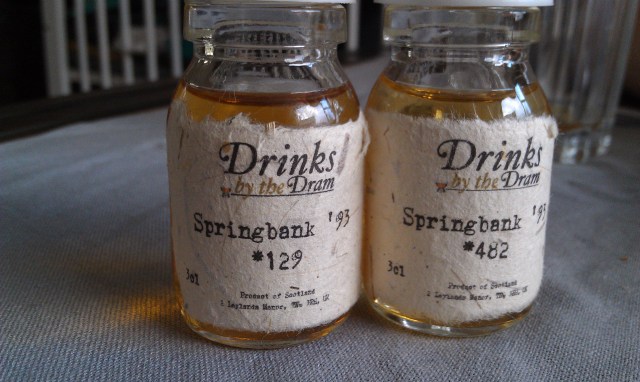
Earlier this week I received a box containing two samples of Springbank in the usual Master of Malt fashion. Waxed lids and rice paper labels and such. There was supposed to be a letter, but that was forgotten. Explanation followed a few days later.

I decided to taste them right off the bat. Springbank used to be one of my favorite distilleries, but there have been some releases with weird finishes that were below par. Shiraz, Madeira, Rum and other things that didn’t really fit my palate.

The Springbank Society releases have been slow coming the last few years too so my collection of Campbeltown whisky has been slowly decreasing from almost 20 bottles to only a few at the moment. Let’s see if these might change a few things!

Springbank 1993, Cask #482

Sniff:
Definetly Springbank, with minerally, salty flavours of liquorice and some wood influence. Bread crust, basalt, sand and sea water. A slight hint of aceton and a very crisp scent of what I can’t describe any other way than ‘winter air’.

Sip:
Sharp, but smooth in flavour. Sugary and sweeter than I expected. Almost something rummy like molasses. The salty notes hit later and the minerals are gone. Sweet honey liquorice.

Swallow:
The finish is smooth at first but has a flavour boost after a few seconds, just before it settles. Liquorice, sugary sweetness that wasn’t on the nose.

I still find their sample service the best available

I still find their sample service the best available

Springbank 1993, Cask #129

Sniff:
The cask influence is abundantly clear and I would put my money on a sherry cask. Maybe refill. So sherry, dry and salty but not as minerally as the previous one. The sherry fruitiness is present but more bitter in the way of peals and peach and nectarine stones. It does get sweeter with hints of chocolate and a hint of mint.

Sip:
Sharp, dry, not too spicy and maybe a little thin. Quite some alcohol I’d say. Sherry, christmas cake, allspice, tropical fruit and a rather bitter fruit at that. Not too woody but again, becomes more sweet if you give it time.

Swallow:
The finish is bitter on my tongue, but sweeter on the other parts of my mouth and throat. Fruit and a light spiciness. Somewhat more wood than previously.

Looking good!

So, I’d put my money on these being a Bourbon cask and a Sherry cask. I like the sherry cask a lot, but I absolutely adore the bourbon cask! For some reason I consider it to be a quintessential Springbank with all flavours you would want.

Yesterday I received an explanatory email stating that one of the samples will be bottled by Master of Malt in the not too distant future. If it turns out to be the bourbon cask, I’m buying a bottle or two. Absolutely delicious!

Bottlings like these might just put Springbank back near the top of my list, if they just stay away from the freaky finishes…

I have no idea to the ABV, expected price, or anything else. I just hope Master of Malt keeps me in the loop as to when they’re released!

Full disclosure: Both samples were supplied by Master of Malt for reviewing.

Posted in - News and Announcements | 4 Comments

Benrinnes 14 – Master of Malt

Yesterday my wife asked me on GTalk whether I had ordered stuff online again. After the default reaction of ‘shit, she found out!’ I released I actually hadn’t ordered anything and this must be another surprise pack!

A single sample was included and it was Master of Malt’s own Benrinnes 14 that was there. A lovely orangy colour greeted me when I picked it up and I couldn’t wait to try it, also because I barely have any experience with Benrinnes save a couple.

Sniff:
Benrinnes 14 by Master of MaltAfter pouring a small glass I get lovely scents of sugared orange peels and other candied citrus fruits. That was about a meter from the glass. After putting my nose in I got more of that. A lot more. Also some toasted oak and what we call ‘Moscovian fruit’. Those little cut up bits of random candied fruit you sometimes find in cakes and Christmas cake. Also some sweet spices and some oriental like chai or something. The alcohol is rather smooth with tropical fruit juice and later also almond paste leading the way. Furniture lacquer too.

Sip:
Sharper than the nose makes you expect, but in line with the 57.8% ABV. A bit spicier too, but all in a good way. Warming and a little dry with a classic spiciness, almond paste and the rather big load of sweet citrus. There’s chocolate too and that makes me think of those orange wedges in a dark chocolate coating.

Swallow:
The finish gets more friendly quickly and really lingers on the sugared orange peels and dark chocolate, plus the almond paste. I get a touch of nutmeg too. There is a certain Indian curry style to it that I find appealing, but that’s in it’s rightful background place.

As they say on their website, this is an awesome whisky. That’s true. It’s very different from the other Benrinnes I know well but there are also some similarities in the style. Master of Malt states this is a heavily sherried whisky. Not so sure about that, but that’s mostly because with heavily sherried I think of ‘the other Benrinnes‘, and that was in an entirely different category.

For a change in recent reviews, this one is actually still available, and affordable!

Benrinnes 14, Master of Malt, sherry cask, 14yo, 57.8%, 1998-2012, available at Master of Malt for € 69.90

Sample provided for reviewing by Master of Malt.

Posted in - News and Announcements | 1 Comment

Karuizawa Spirit of Asama x2

When at Maltstock, Billy from the Whisky Exchange let us taste a dram from a new Karuizawa series called Spirit of Asama. I don’t know if I remember correctly, but I think this it a range of new vattings from Karuizawa based on the stock of Number One Drinks.

It will probably not consist of the really high end thirty something sherry bombs but a more gently styled vatting of casks. I think there still will be some sherry casks, but not the deep brown ones that everybody wants but cannot afford.

A while after Maltstock I got a pack of samples from the same Billy and The Whisky Exchange containing that same Spirit of Asama sample, and another one. The first is at 48%, the second at 55% ABV. Apart from that I don’t know much about them (yet).

Karuizawa Spirit of Asama 48%

Sniff:
A much lighter style of sherried Karuizawa (by the colour and the scent). Quite friendly with old leather, shammy like. Wet wood, sweet with over ripe fruits. Papaya and mango. On the brink of rotting fruit sweetness, just pleasant on the nose but on the brink of being too much. It does get less cloying and less sickly sweet after a while. The typically Japanese style of wood spices are present too. Sandal wood and such.

Sip:
It’s a bit sharper than I expected and more spicy too. Red cinnamon, pepper corns, ginger. Also some grilled tropical fruit and sweet apple as well.

Swallow:
The finish gives me a bit of dry sherry like notes. There’s some chocolate, raisins, cashew nuts. Not very long though.

Spirit Of Asama

Karuizawa Spirit of Asama 55%

Sniff:
It starts of rather comparable to the 48%, with some fruits and the shammy leather. It quickly goes in a different direction with more feinty scents of mushrooms. There still is that fruity sherry base for the leather and mushrooms though. Also a tad minerally, not-too-sweet peach and sweet apples. I prefer this to the 48% so far.

Sip:
The flavour profile is rather light with lots of fruit, sweet spices. Some papaya again. The fruitiness gets a bit more crisp like the tinned fruit salad you can buy from the bottom shelf in the supermarket. Sugary syrup too, with some spices. Almost no wood influence.

Swallow:
The finish isn’t the best I’ve ever had, with a medium length, rather sweet with the syrup and fruit salad again.

Weird. I expected to like the stronger version better than the 48% one, but I think I will chose differently. The first one I thought to be a bit more coherent and not so strangely diverse as the 55% one. The last one started off very interestingly but I think it didn’t pull through in the end game.

Depending on what they’re going to cost these might be very cool introductions to what Karuizawa is about, if you’re unwilling or unable to spend the £ 200 on the really old, really good casks.

They’re not up on the website yet, but both will be for sale at The Whisky Exchange.

Posted in - News and Announcements | 1 Comment

Millburn 1974-2008 – Blackadder Raw Cask

A while ago I reviewed a sample of this whisky’s baby brother. The Millburn 1974-2000, by the same bottler. While that was a good whisky it had way too sharp an alcohol edge, from my point of view. With water the flavours improved quite a lot, and in retrospect I might have been a bit harsh in my judgement.

Anyway, this older version of a very similar cask is reviewed now. I had this in my own collection since its release in 2008. At the time it was the most expensive whisky I had ever bought and apart from two or three exceptions it’s still right up there.

Sniff:
Millburn 1974-2008Sweet with a ‘dirty sherry’ or a sherry refill edge. This is mostly from the wood itself, since the cask has been used for bourbon, according to the label. Sweet citrus, lemon curd. Also rye bread, bread crumbs with quite some spices. Ginger, brown sugar, allspice and some old sugared coconut like a Bounty bar.

Sip:
Spicy with some pepper and toasted oak. Dry rye bread again with grilled fruits. It softens quite quickly with loads of thick and sweet vanilla. Some unexpected tropical fruit as well.

Swallow:
The finish is very smooth and very warming. Lots of fruit with sweet citrus again, and some tropical stuff like peach. There is a lot going on here, very complex and very flavourful.

Lots of cask sediments againUnfortunately, these tasting notes were made at the last possible moment. That means the bottle is now completely empty. Big bummer since this was one of the highlights of my collection. The thick layers of vanilla and other bourbon-cask-influenced flavours were so pronounced that this is exactly what I love about old bourbon casks.

It’s a lot more a gentle giant than the other Millburn and this has my preference bigtime.

Millburn 1974-2008, Blackadder Raw Cask, 55.1%, ‘From an oak hogshead’. It used to cost around € 180, but according to Whiskybase I’ve paid too much.

Posted in - News and Announcements | 1 Comment

Whisky People 3.2 – Rob Stevens

Let’s continue the web interview I started earlier, with the Whisky King himself, Rob Stevens.

This part will continue where we left off Saturday and will focus more on Rob’s view of the industry. No less interesting I might add!

MF: Apart from your favorite whiskies being a Springbank, Caol Ila and Highland Park, there also must be a whisky you remember as the worst you’ve tried. Tell us which, please!

The Tasting Room at the shopRS: It’s one I have baptised as the ‘mail man whisky’. During the first whisky festival in Amsterdam I was the only importer of indie whiskies. Among the brands I represented was Dun Bheagan. Outside as well as inside the church it was just above freezing levels. I had just received an Isle of Jura 1986 that morning and hadn’t tasted it yet. It would be the first dram the visitors would taste that night, and it being a rare thing would be a guaranteed success!

After the festival I tried at room temperature. Let’s just say it took me 12 years to sell 120 bottles… I used it a lot in tastings, to show people a ‘bad’ whisky from a cask that could only have been bottled for the money. The bottler later heard I referred it as a whisky that smelled like the mail man (think of the rubber bands, wet coats and such). They weren’t pleased…

MF: Your list of favorite drams is one I can fully agree with. Luckily I have a bottle of each of those waiting to be opened in the future! I notice however, that all those bottles are almost a decade old. Do you think whisky has become less special or is there some nostalgia in your choice as well?

RS: Back in the days (the early 2000s) there weren’t as many jewels as there are now. The ones you did discover were truly sensational because of that. Nowadays, the availability is so vast that you have to be an alcoholic to get anywhere near tasting them all. But also, the nostalgia is certainly a factor in my choices. Just like tasting a dram at a distillery is always better than tasting it home alone, right?

MF: The logical follow up question: Do you think whisky used to be better some years ago than it is now? A few decades ago, for example. It’s an opinion you hear quite often from people who have been around for a while.

RS: Years ago the availability was much less, which also means the availability in bad whiskies was less. Now it seems that every cask should be bottled as a single cask, just to supply demand. For that reason I veer towards distillery bottlings, because me and my customers have been disappointed by indies more often than before.

MF: Since the whisky virus is running rampant the last few years it seems that everyone and their brother has a ‘specialised’ shop of a dedicated whisky shop. The same goes for indie bottling lines. Do you think this resulted in a decrease in quality? I’ve noticed that you have become more and more picky in what bottles are represented in the shop. You don’t fill your shelves with just anything that is released.

RS: Well, I think I have an advantage on all those newbies, because my experience tells me how new and old customers will react to the overdose of bottlings eventually…

MF: You used to be importer of quite some brands. Also, a few years ago many brands were imported by many different shops and companies. Now it seems that that has concentrated on a few number of companies. Whisky Import Nederland and Bresser & Timmer, for example. Did that influence your choice to move towards Original Bottlings?

RS: I noticed the sales of indie bottlings decreasing since 2006. In Holland the 2008 crisis didn’t help. It’s understandable that indies start shopping around for new importers that offer better deals. But, if the market for indies isn’t growing and new brands are continuously made available it’s kind of logical that consumers shift their interest a bit. However, I don’t think the grand total of sales for indies is growing.

Bottlers like Dun Bheagan, Hart Brothers and maybe even larger ones like Blackadder are finding that out too, just as the new batch of importers. You notice that from the brands the importers represent through the years.

What I regret is that old indies like Cadenhead’s are affected too. They used to be first in line to pick from the available casks.

MF: Some brands that were in your portfolio are now very small or have disappeared. Think of Dun Bheagan and Hart Brothers. Except through tasting by the importer I never see or taste them anymore. I also hardly know anyone who ever buys a Cadenhead’s or Blackadder bottling. Do you think those bottlers have been overtaken by others and sometimes newer bottlers? (Think of Douglas Laing, Adelphi and G&M, but also David Stirk’s Creative Whisky Company)

RS: I think Dun Bheagan fell for the whisky-cowboy trap. James MacArthur also knew better and by now they’ve had many importers already. Hart Brothers is a different story since they went bankrupt. One of the brothers (the whisky-knowing one) quit and the marketing brother continued. Never heard from them again until some salesman walked in and asked if I had ever heard of Hart Brothers… Absolutely no knowledge of the market.

I trust the old guard more than the new guys and in the quality of offerings from G&M, Cadenhead and Signatory. I’ve always sold them well in the shop and the whisky never lets down. Only Cadenhead went to an importer that won’t do business with me and the other way around. A bummer with such a nice brand.

MF: You said you go for OBs for the shop because of consistency and the growth of bottlers has decreased the general quality. Aren’t you afraid you’re missing out on the real jewels that sometimes pop up?

RS: Missing the jewels is a bummer indeed, but more for me as a whisky loving salesman. Commercially it’s not such a big deal, since the availability is so incredibly small that you can only move one case at a time. Especially thinking of the jewels I bought in the past and can’t even sell them at a 25% discount…

MF: That’s it for my questions. I might have some follow up or might want to chat again in the future!

Although most whisky shops in The Netherlands are closer to my house than this one, I still go to Den Bosch regularly to visit Rob’s emporium. The sheer amount of older bottlings is terrific and although the indie bottlings from years ago might not represent the best bottlings of those days, there still are many gems to be found!

Especially the tasting are recommended and usually consist of rare and unavailable things like the Springbank Millennium Collection or 4 consecutive Bunnahabhain Feis Isle versions!

www.whiskykoning.nl

Posted in - News and Announcements, Caol Ila, Highland Park, Springbank | Tagged , , , | 2 Comments

Whisky People 3.1 – Rob Stevens

I decided a while ago that it was time for another report in the Whisky People category. I chose Rob Stevens, who owns and runs the Whiskykoning shop in Den Bosch. I used to visit that shop every week until I moved away and found myself 110 kilometers down the road from it. He is the guy who helped me develop an interest into a hobby into an obsession.

Since I’m quite far away we chose to do an email-interview, which is exactly that. You email people with questions, get answers and email more questions. I’ve distilled that into 2 blog posts, since it turned out too big to do in one post.

Another delay was the VAT increase in Holland that happend on October 1st. He had to reprice about 1250 whiskies and a few hundred other bottles of booze so that kept him busy as well.

MF = Malt Fascination, RS = Rob Stevens

MF: On the website I read you’ve switched careers from IT to whisky in 1996. What made you do that?

RS: During the late 1980s and early 1990s I started catching the whisky bug. I visited Scotland regularly and visited the few whisky shops it had. I found it strange that there were so few, and that it was very hard to find good shops and bottles in The Netherlands. I talked to Neil Clapperton (who ran Cadenhead’s shop in Edinburgh) a lot. He and his boss, Hedley Wright (Springbank and Cadenhead) were thinking about opening other Cadenhead shops throughout Europe and Great Britain. I told him I wanted to run a shop and he said “Just go for it”. That was the push I needed.

The first Cadenhead’s Whiskyshop outside Britain would be in The Netherlands. I was living in Eindhoven back then and convinced Clapperton and Wright that that would be the place for it. I toured Amsterdam and Eindhoven with them and showed them possible locations. The entire process took a few years and resulted in a business plan with which I went to the banks. The biggest issue was that Cadenhead didn’t allow non-Cadenhead bottles in their shops. Understandable, but that wouldn’t work in The Netherlands since you also have to make a living. I ended the talks and they were dissapointed. In the end it turned out to be the right decision, look at what happened to Cadenhead’s Amsterdam (MF: It failed once, restared and failed again within 2 years).
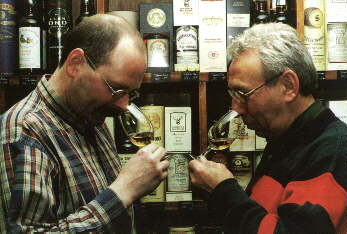
Rob and StanI changed my plans to the ‘Stevens Whisky Shop’ with everything whisky related you could think of. In 92/93 that wasn’t as much as it is now, but the dream of my own shop was born. I went for it.

Eventually I was tipped that Stan de Koning, in Den Bosch, wanted to stop with his off-license. There were three shops with a significant amount of whisky during those years: Verhaar, Van Wees and De Koning. In 1995 I walked through the doors of the latter and told him I wanted to take over his business.

MF: You mention that the first plan was to open a Cadenhead’s shop but that failed because their ‘limitation’ on what you could sell. Still, you have/had quite some Cadenhead’s bottlings in your shop from those days. Bottles that were filled in the late nineties. Did some kind of partnership happen that proved to work or did this happen through regular sales channels?

RS: Since I started my shop I was always able to buy directly from Cadenhead’s until their shop in Amsterdam started. Then everything had to go through there but the shop never wanted to wholesale. Bummer. Nowadays Cadenhead’s is imported through Bresser en Timmer.

MF: Off topic, but since I’m in IT too, what kind of work did you do in that sector?

RS: I started in 1973 at Philips as a computer operator. The 23 following years I worked as a programmer, system designer, information analyst and project manager. From 1986 onward I worked for different software houses and as a freelancer.

MF: Back to whisky! On your website there’s an article about the takeover in 1996. In it says that a Balvenie opened the flood gates for your whisky collection. I had a similar moment in your store (Caol Ila 18). If your passion was unleashed on such a specific moment, was the choice to make it your profession a similar revelation? Did you make a snap shot decision (and over which dram did it happen)?

The Balvenie Founder's ReserveRS: The Balvenie that made my interest in whisky rise to the next level was the Balvenie 10 year old Founder’s Reserve, the one in the cognac bottle. At that moment I saw the light! When Hedley Wright, during conversations, poured mostly his own Springbank whisky there was no stopping me. Because he was in the industry for such a long time he had so many different Springbanks and Cadenheads in his bar that we went for the home run right away. No training wheels, just like you did when you walked into the shop here.

Because I was so enthusiastic I tried to sell as many Springbanks in The Netherlands as I could. Thanks to that, I ‘oversold’ some of them which means I didn’t even keep a few bottles of it for myself, except for my favorite 21 year old. And then again, where could you buy Springbank before 1996? The shop in Den Bosch under Stan de Koning’s guidance already was a Springbank Dealership, what would be called an ambassador now.

MF: I’ve already known the 21 year old is your all time favorite. Are there any other highlights that you’ve encountered in the past three decades?

RS: There have always been three favorites on my shelf. After the original Springbank 21 there’s the Caol Ila 10 by Hart Brothers and the first release of Highland Park 18. That Caol Ila is the most refined one I’ve encountered and only the 12yo BO comes close. Peppery and sharp, but never too much. Liquid razorblades without ever become uncomfortable. From that Highland Park 18yo I unfortunately sold so much, because it was so impressive and new that I regret not keeping more for myself…

Through some ‘Bramming’ I’ve been able to get an extra box, but the last one will be opened shortly…

(MF: Bramming is named after Bram van Glabbeek, whisky friend to Rob and president of the Usquebaugh Society. When a ‘one per customer’ bottle is released he buys one at every friendly liquor shop untill he gets the one or two cases he wants.)

ShopMF: In the shop you have some other booze that isn’t whisky, but apart from Port it’s all very minimal. What made you make the choice to not sell anything else so early?

RS: In ’96 you couldn’t really start a whisky shop from scratch, the market was too small. Even with only the three names mentioned earlier. Because I started in an existing shop I started ahead with a solid customer base. By reinvesting all profits for many years I could make the shop grow to where it is now. Decreasing the ‘regular’ liquor went slowly. If it didn’t sell, I got rid of it. The port was quite a significant part of the shop before I bought it, and now the port still functions as the ‘pardon port’. That hasn’t changed since the ’80s!

(MF: The pardon port is a bottle bought for the misses at home when you think you’re getting in trouble because of the most recent overspending on whisky. I know it. I’ve been there. More than once!)

End of part one. Soon I’ll write up a more in depth look into Rob’s opinion on the industry.

Posted in - News and Announcements, Caol Ila, Highland Park, Springbank | Tagged , , , | 4 Comments

Radio Silence

I’ve been virtually absent from the Internet for the last couple of days. Almost no Facebook, Twitter or Email. I didn’t even write a proper blog post apart from the most recent review. I had some posts planned that have been postponed.

All with good reason of course!

Most of you who regularly check my Facebook page and saw some updates about 5 months ago know that my wife Anneke was hatching our firstborn and about an hour after we went to bed on Thursday her water broke. Not even 7 hours later our daughter was born.

We’ve named her Ot.

My girls

Posted in - News and Announcements | 7 Comments

Karuizawa 1984 First Fill Sherry Cask #4021

The 2nd Karuizawa from the newest batch of The Whisky Exchange releases. This one is a more traditional sherry cask, which is the style that put Karuizawa on the map. It sold out in hours so it’s long gone by now. I don’t think anyone who got a sample of this got their blog post out in time!

The popularity of this distillery keeps growing and that means the initials prices of a bottle keep rising. I think The Whisky Exchange is very reasonable with the starting price at £ 200. Still a lot of money, but compared to the more recent Diageo Special Releases, or Highland Park’s Orcadian Vintage…

Sniff:
Sambal sauce, the fried kind (I believe it’s called Sambal Badjak) with wood pulp, cork trees and sour cherries. Japanese plum wine, dark chocolate, light Christmas cake and stewed strawberries. With added water it gets more accessible, but the scent profile stays rather similar.

Sip:
Karuizawa 1984, at the Whisky ExchangeLoads of fruit, dry and spicy as well, with quite some alcohol and it’s very hot. Red fruits, quite some sharp wood flavours. Sharp spices as well as allspice. Kahlua, pepper, a bit smoother and typically Japanese and sherried Karuizawa with some H2O.

Swallow:
The finish is long and shows alcohol, chocolate liqueur, forest fruits. It feels a bit thick and syrupy with Christmas cake, allspice and with water it shows some Jalapeño peppers…

While this is a stunning and more traditional Karuizawa in all senses of the word, my preference of the two released by The Whisky Exchange lies with the bourbon cask. Lately my preference in general is there and it’s the odd one out which shows that Karuizawa could be anything else then sherry bombs. And be ridiculously good at that too!

This one is a stunning whisky nonetheless and well worth the 200 quid it went for. I’m kind of scared it’s going to pop up on auction sites soon and skyrocket in value. There is something to say for it since it’s a very complex and intriguing dram!

Karuizawa 1984, First Fill Sherry Cask #4201, released by The Whisky Exchange and sadly no longer available at the price of £ 200

Posted in - News and Announcements | Leave a comment

Karuizawa 1982 First Fill Bourbon Cask #8497

Recently I received a package of samples containing some new releases from The Whisky Exchange. In there were some elements of Islay (to be reviewed) and some Japanese drams. Four Karuizawas to be exact.

TWE samples!

Karuizawa Noh 1995 at Whiskybase

Image from Whiskybase

Since I tasted my first Karuizawa after a guess buy of the first Noh release I was hooked. Back then they were more or less affordable and not sold out in 30 minutes after being released. Those were the days…

This one, however, is a very strange one since it’s a bourbon cask. Karuizawa is famous for their ridiculously good sherry casks. Also they (if I’m not mistaken) used Golden Promise barley, so they were quite like Macallan in the old days. Of course, the Japanese bit makes it quite different.

Sniff:
Very rich with an odd combination of mint, leather and lots of dry wood. Very spicy, saw dust and cinnamon sticks. Also some furniture polish.

Sip:
Karuizawa 1982 at The Whisky ExchangeFull and not too sharp. Karuizawa usually comes in weighing above 60 % ABV. It’s a bit hot though, so that might be a Japanese thing instead of purely an alcohol thing. Chili pepper, peppercorns, wood, leather wax, leather, mint, cinnamon and a hint of crumbly old paper. Quite some small hints of dark forest fruits. Brambles, cherries, strawberries. Some citrus fruit as well, but very faint.

Swallow:
The finish is almost endless with heaps and heaps of flavour. Furniture lacquer. Light hints of strawberries, wood. A strange note that reminds me of the woody stalks of bushes, not trees. More ‘twig’ than ‘trunk’, if that makes any sense.

For the odd one out, this being a bourbon matured dram, it’s bloody terrific. If our whisky club hadn’t released a BenRiach 1976 this week, I’d have bought this. I guess they’re almost gone and the only reason it’s still available is the maturation and ABV, I guess.

There is layer upon layer of flavour so this will keep you busy and it doesn’t come cheap at £ 179. Every pound is worth it in my book.

Karuizawa 1982, 1st fill bourbon cask matured, cask #8497, 46% £ 179. Only available at The Whisky Exchange.

Posted in - News and Announcements | 2 Comments