Peat Monster, 46% – Compass Box

The third and final Compass Box whisky for a little while, unless I suddenly pop open my bottle of Hedonism. I don’t see that happening anytime soon though. Mostly because I’m still in the process of decreasing the amount of open bottles I have. Still some 12 to go before the end of the year!

Peat Monster was one of the first bottles I bought when I was getting into whisky a bit more some 9 years ago. Especially due to the name and the prettiness of the bottle, to be honest. I didn’t know anything about anything, so Compass Box, Vatted Malt (in those good old days) and other terms used on the label were new to me.

The unfortunate timing of this bottle, back then, was that I was expected some monstrous dram, since that was what I was going for in those days. Everything had to be high ABV and high phenol counts. Ardbeg Still Young, some Laphroaig indies, Caol Ila cask strength and such bottles all found their way home. Then came the layered smoothness of the Peat Monster. At first I wasn’t thrilled about it, but when the end of the bottle came near I started liking it more and more.

A few years after that I even considered buying one of those rare Magnum bottles of Peat Monster at 1.75 liters. They were relatively cheap, but my budget didn’t stretch that far at the time. Kind of a bummer, since it would have been epically unpractical and gimmicky to have that sitting on a shelf or table somewhere.

Compass Box Peat Monster

Compass Box Peat Monster

Sniff:
A very oily texture on the nose at first, but with quite a lot of raw smoke in it. Very Caol Ila like. I get some straw and heather, salt and extra dark chocolate. Very nice and elegant.

Sip:
The palate starts with some pepper , dried heather, vanilla and smoke. It’s rather rich and quite sweet but not overly so. It also has some salt and sea weed.

Swallow:
The smoke is less raw than on the nose and rather rich and sweet. There’s some oak too, pastry cream and a light dusting of pepper. It’s not very long.

It’s a lovely dram. One for the wishlist and very much worth the money (it’s under € 50). Not the most complex dram you’ll ever have in the price bracket, but one that has all the loveliness of the Islay drams mixed together to a very smooth and pleasing sum of its parts.

Kudos to Compass Box for consistently producing this stuff! I really love it. My favourite of their regular expressions!

Peat Monster, 46%, Compass Box, available at Master of Malt for € 46.
The Magnum bottle of 1.75 liters is available from The Old Pipe at € 107!

Thanks to Compass Box for sending me this sample!

Posted in - Blended Whisky, Compass Box | Tagged , , , , , | 3 Comments

Millstone Rye 6 year old for Usquebaugh Society

While this looks like the beginning of yet another review, it is not. This is a blatanty commercial post. Not for me, however, but for the club that I am part of.

We’re called the Usquebaugh Society and are the largest whisky club of the Netherlands and will be celebrating our 25th anniversary next year.

This is not about that. This is about our club bottling of this year.

A while ago we went to the Zuidam distillery in Baarle-Nassau, on the Dutch-Belgian border. There we selected two different casks to be bottled by the club for this year’s exclusive bottling.

Bottle one was a PX Sherry matured Single Malt from 1999 (I think) which has sold out (It was bottled per request, so all bottles sold per definition) but the second bottling hasn’t. This one is an exactly 6.5 year old Rye Whisky bottled on May 30th of this year.

It’s bottled at 43.3% ABV, which is at Cask Strength! Zuidam likes to experiment with their spirit and this one is no exception. It was racked at 46% instead of a more usual 55% (at Zuidam that is usual).

Since there are quite some bottles left over since the cask turned out to contain about 70 more bottles worth than expected (a massive miscalculation if there ever was one…) this one is now also available to non-members of the slightly increased but still very affordable price of 50 euros.

You can order up to three on our website here. Have fun ordering. Know that this wee Rye baby was my favourite of the eight drams tasted at the distillery!

Posted in - Other Distilleries, Zuidam | Tagged , , , , , , | 1 Comment

The Science and Commerce of Whisky – Ian Buxton and Paul S. Hughes

Of course, on holiday you read books. At least, I try to. In this case I brought a pile of stuff I had lying around for quite a while and tried to go through as many as possible. I made it through four books. Three of those are booze related and will be reviewed.

When this came out the better part of  year ago I was contacted by the Royal Society of Chemistry whether or not I was interested in receiving a copy for review. Of course I was, but they wanted my review in some science-y periodical of theirs. I don’t think my chemisty is up to scratch and the publishing was to be exclusive (so no blog review) made this not happen. So, I ordered the book myself and technically, because of that this post costs me about 32 euros.

The Science and Commerce of Whisky

The Science and Commerce of Whisky

Anyway, the book itself. There is a quite clear distinction in the chapters written by Buxton and Hughes. Buxton’s focus, obviously, on the marketing, history and trends in the whisky industry, while Hughes’ focus on the chemistry (him being a professor of fermentation and distillation at Heriot-Watt in Edinburgh).

The start of the book is an introduction into what whisky is and its history over the entire known existance of grain distillates. Fairly interesting but not much new information. Of course, some other aspects of the history are highlighted compared to other books, but nothing shocking so far.

The chemistry of each part of the whisky making process is handled next and while I did understand the bits about distilling and maturation rather well, I couldn’t make anything of the “before-distillation chapters”. This is far too technical for a layman like me. It focuses heavily on the chemic reactions to create alcohol and flavours in the entire proces of steeping, malting, storing and fermenting barley in which there is a lot of in depth technical data shared. Let’s keep in mind that this book is written as a scientific piece, and not targeted at douches like me.

I wasn’t too sure about the marketing chapters before I read them. Were they going to be interesting at all? It turns out they are. There is a lot of information on how marketing has developed over the last two centuries, when whisky branding was started until now where marketing is big business and often handled on a global level.

I’m not going to share any examples of interesting facts in the book, but I do want to say that it differs quite a bit from, for example, Ingvar Ronde’s Malt Whisky Yearbook which focuses heavily on actual figures of the past annum. The Science and Commerce of Whisky focuses on how the marketing engines actually work in certain situations and what the effects of certain actions are. What’s also nice is that some marketing has always been based on twisted truths and that this is not something of the last decades, as whisky geeks often proclaim.

So, concluding, this is a book for whisky geeks who, preferably, have some affinity with chemistry. If you don’t, or simply don’t care about that there’s still quite a bit of interesting stuff in here, but you more or less cancel out half the book. And since this book does set you back of three tenners, it’s pretty expensive for another take on history and marketing of whisky. Still, being a booze geek, I highly recommend it.

I got my copy at Play.com for a little over 30 euros.

Posted in - Book | Tagged , , , | Leave a comment

Spice Tree, 46% – Compass Box

It’s been a while since I promised to write up the other two drams I got sent from Compass Box. This time it’s Spice Tree, soon, it’s going to be a review of the Peat Monster.

The Spice Tree it, obviously, a dram that focuses on spicy flavours. And probably some wood too. I think I have previously had a sip of Spice Tree, but I can’t remember when or where. I did remember Oak Cross, and Peat Monster too. Some others I recall as well, and I have a sample of The General waiting for me in the UK. Looking forward to that!

Spice Tree has a bit of a history to it, since the focus of this whisky is on the Toasted French Oak that gives off the spicy flavours. When it came out Compass Box added oak staves to the inside of the cask but the SWA got pissed about that and decided they couldn’t. To make it a legal whisky again Compass Box changed the recipe to use new Toasted French oak heads to the cask instead of some extra oak inside the cask. Clever, but I wouldn’t have minded the initial recipe.

Compass Box Spice Tree

Compass Box Spice Tree

Sniff:
I’m not surprised to find a lot of wood on the nose. It’s spicy too, which still does not surprise me. It’s slightly salty with lots of allspice. I even find some ‘Provencal’ herbs you can get at the supermarket for cooking, as well as some curry spices. Very focused on the kitchen cupboard, this dram.

Sip:
The palate has a spicy feel to it without that coming from the alcohol. Oak, white pepper, chili pepper too. More oak, dry grass (that’s called hay, you idiot), more oak and French oak to boot.

Swallow:
The finish is more towards the spices again, contrary to the palate’s oak focus. Rather rich and pretty long.

After about half an hour in the glass it gets a bit thinner and more gentle on the palate.

I’m still considering what to say about this whisky, but let’s start with me liking this over the Oak Cross. I think they’re doing a comparable trick, with the oak all over the place. I do feel the added spiciness keeps this one a bit more interesting. It has a bit more depth.

I generally like spicy whiskies and this one is no exception. There’s a lot going on and the curry spices at the same time as the more gentle French kind is an interesting twist.

A bottle of this stuff currently sets you back less than 50 euros which is an added benefit, for such designer whisky. It’s not often that I use that term in a positive way. What I mean by it is that the guys at Compass Box set out to make a certain kind of whisky and started buying, aging and blending towards that goal. Usually those whiskies have a rather short-lasting draw or feel too manufactured, but this one doesn’t.

Spice Tree, 46%, Compass Box, available at Master of Malt for 47 euros.

Thanks to the folks at Compass Box for sending me this! Much obliged!

Posted in Compass Box | Tagged , , , , , , | 2 Comments

Back from the family holiday

So, I’ve been MIA for about three weeks now. No longer. After a long weekend in the Ardennes of Belgium I came back home to get my car fixed (the AC broke) and went straight back south to Burgundy.

It was time for our family holiday, while it still was possible. The misses being 33 weeks pregnant and all. We went on a little camping trip in the vicinity of Autun. Little did I know that there is an area in Burdundy where there is no wine industry…

On our weekend in the Ardennes with 8 others, an annual weekend we have with friends, I usually take some whisky with me and this year I brought some left over samples from a couple of Twitter Tastings, and other stuff that I had sitting on a shelf, reviewed but not finished. I think we went through some 100 samples while playing Cards Against Humanity, barbecueing and other stuff.

Right after the weekend, except for the AC fix we needed, we went camping in France. The misses, our little girl and I. During that trip we mostly sat on our asses watching the little one tiring herself in the playground on the campground. I did take some whisky with me to finish but I did drink less than I expected. Of course, since we were in the middle of shit, I didn’t blog a letter. Hence my absence.

Finishing Laimrig. A great dram

Finishing Laimrig. A great dram

Cool, booze related stuff that happened in France:

I tried the Wild Turkey 81. I love the 101 and expected less of this. It’s lovely however, fierce and spicy even though it’s quite a bit lower in ABV. Unfortunately, I didn’t get around picking up some for myself, which is a shame since they were only 16 bucks a pop in the supermarket.

I almost had an empty bottle of Knob Creek Single Barrel explode in my hand. Apparently, when there is a drop left and you leave in the sun for a couple of hours the alcohol evaporates and the pressure build inside the bottle. When I took of the cork (I always keep the cork) it shot off, there was a fume coming out of the bottle and the glass was about 60 degrees Celcius. Weird stuff.

Ot adapting to what mum and dad like to spend their time doing

Ot adapting to what mum and dad like to spend their time doing

On the first day in France I visited Michel Couvreur Whisky in Bouze-les-Beaune. There will be a story on this on the blog but that will be in October or so. I am first putting it in the Usquebaugh Society’s club magazine. In short, it was rather cool. I tasted some of their releases, saw the cellars, had some cask samples and a 39 year old Manzanilla Sherry.

We bought a case of Cremant de Bourgogne. Technically it’s the same as Champagne, but since it’s from the wrong area they can’t call it that. Apart from that it’s the exact same, but a LOT cheaper. Champagne should be cheap too, but someone has to pay for the ridiculous amount of marketing and promotion spent on the high end brands.

The Marche de Vins in Beaune is a pretty nice place for a tasting. You can go in and for 11 bucks you can taste 7 sips of different high end wines. For a bit more you can taste more. For a bit more still you can taste some Grand Cru versions of typical Burgundian whites and reds. With a one year old tagging along, you stick to the shorter tasting though. Still pretty good and we picked up some nice bottles for when Anneke is no longer pregnant.

I read some books on booze and one of them was about Absinthe. It revamped my interest in that and pastis, so I’m going to try to get my hands on some proper drippers to do some reviews of that. I still have some Absinthe samples sitting around, and now some pastis as well. Interesting stuff, Ralphy would say.

Posted in - News and Announcements, Bowmore, Knob Creek, Michel Couvreur | Tagged , , , , , , , , , , , , | 1 Comment

Venturing into darkness. Another three Sherry reviews

During the Sherry Twitter Tasting I wrote about earlier, we didn’t stop at two. Of course we didn’t as there is more than Fino and Manzanilla to come from that neck of the Spanish woods.

As we continued our Twitter assault and tried to become trending, I kept swearing and cursing everything Apple and Ipad related (I still believe the software is utter shite).

The Sherry we drank became more approachable. Not necessarily because it wasn’t the first drink of the evening anymore but also the flavours got more easy to comprehend. It was no longer based on olives, walnuts and seawater. It got more fruity, sweet and sticky.

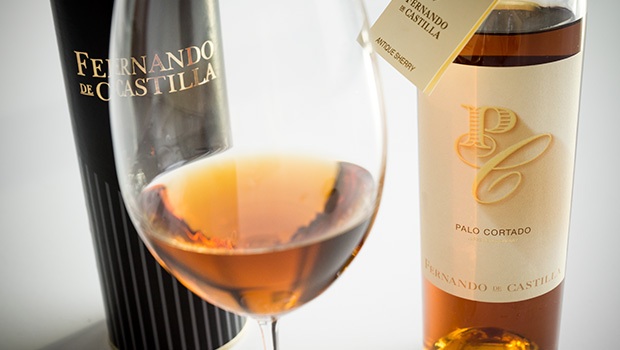
Antique Palo Cortado, 20%, Bodegas Rey Fernando de Castilla
At first I got a massive hot of toffee and hazelnut praliné. Demerara sugar follows, as do stewed fruits, plums and dried apples. Soft cinnamon. It does get dry like the previous two, but it does take quite a while. The palate is thinner than I expected, more wine like and it has that yeast flavour I encountered earlier too. Dry, with a bitterness like raisin twigs. The finish has a sweetness that reminds me of some sherried Glengoynes. Wood, dryness, bitterness and hazelnut and toffee.

Palo Cortado. Image knicked from Sherrynotes.com

Palo Cortado. Image knicked from Sherrynotes.com

Oloroso ‘Pata de Gallina’, Juan Garcia Jarana, 20%, Lustau Almacenista 2003
It’s full and creamy, with caramac bars and plums. Also nuts, fruit and tawny port like scent on the nose. The palate is dry and comparable to the Palo Cortado, quite light and dry, with a hint of bitter caramel. The finish long, caramelly and has quite a lot of oaky flavours. It’s not very sweet, but has a flavour of dates.

Oloroso, image from Sherrynotes.com

Oloroso, image from Sherrynotes.com

Colosía Pedro Ximénez, 17%, Gutiérrez Colosía 2014
The only kind of sherry I have any experience with. Probably because the whisky people promote it the heaviest, and it’s lovable since it tastes like a Christmas dessert.

On the nose this one is not as sweet as I expected from previous encounters with PX, and it even has a weird sellery scent. Yellow raisins but also apples and pears. The palate is thick and treacly like some rums and ports I know and has flavours of raisins, dates, figs, coffee syrup. It’s ridiculously rich. The finish continues down this road and is as rich as expected, big and sweet, with dates and Choya, that Japanese plum wine (thanks for naming it, Gal).

PX to he max. Thanks to Ruben for the image.

PX to he max. Thanks to Ruben for the image.

This batch of wines was a little more approachable than the first two. That makes the order of wine a little strange to me, but the richness in the latter three does explain all. It’s pretty hard to taste anything after the PX, except for more PX.

I must say I loved the Oloroso and the Palo Cortado more than the PX. I find the overkill of sweetness on that does lower the complexity a little bit. After having a second glass of the Manzanilla I must say I came to like and enjoy that too, but it is an acquired taste. Strange stuff, this sherry. It needs some more exploration, and I think I will try to do that with some interesting ones I might be able to pick up here and there, and when I have some expectation of drinking the bottle before it goes bad.

Posted in - Sherry | Tagged , , , , , , , | Leave a comment

International Sherry Week (with some reviews)

I know nothing about Sherry. Well, nothing that matters anyway. I know where it’s from. I know the casks are used in Scotland to mature or finish some kick-ass whisky. I know Ruben likes it quite a bit.

Usually I’m also not too fond of International <enter booze here> Week/Month/Day thingies. Most cases, especially the World Whisky Day shenanigans, are mostly used for commercial purposes. There’s Bourbon Heritage Month in September, which to me is just an excuse to drink more bourbon. This time, I think the drink deserves some attention since there’s almost no sherry market left compared to the seventies.

International Sherry Week deserves attention. Sherry deserves attention, if only to create more casks for the Scottish whisky industry! Apart from that, it’d be pretty nice if the drink from those casks is nice too.

After initially thinking I wasn’t going to be part of last Tuesday’s Twitter Tasting, we changed plans at the last moment and I was in after all. At least, for a bit. My laptop is broken, my Twitter client on the iPad thought it was a nice moment to crash every five seconds and doing a tasting with a phone keyboard is just hideous. So, after some swearing, and restarting and re-installing I joined in just before the third sherry was tasted.

#1: Tio Pepe En Rama 2014 (González Byass)
En Rama for sherry means that the wine is a lot less filtered as it normally would be. In this case I think it boils down to non-chill filtering like in whisky. At least, it’s comparable. It supposedly leaves a lot more flavour in the wine but also some yeast cells and some proteins which can clot.

Tio Pepe En Rama 2014. Image from Sherrynotes.

Tio Pepe En Rama 2014. Image from Sherrynotes.

On the nose it started with a rather sweet white wine, somewhere in the middle between Chardonnay and Muscatel. Right behind that I got a strange, cheesy scent. Goat’s cheese or sheep. Like the crust of a Camembert. There is some yeastiness going on too, but in an unexpected, beer-like way. The palate starts with wine again, but is a bit thinner than I expected. Unripe grapes, a yeast foam and it’s all rather dry. The finish has a certain dry port-like quality with minerals, chalk and slightly acidic.

#2: Solear En Rama – Primavera 2014 (Barbadillo)
Another En Rama sherry, but this time it’s a Manzanilla, compared to the previous Fino. I’m not sure what makes the difference between each kind and have to read up on that, but I haven’t gotten around to it yet.

Solear En Rama Invierno 2013. Image from Sherrynotes

Solear En Rama Invierno 2013. Image from Sherrynotes

This one is rather similar on the nose, but less sweet. The cheese scent is back, but the wine and grape is more or less gone. There’s a slight spiciness with walnuts. I’m having a “Rambol cheese” association. It’s very earthy, almost farmy with dirt and manure. In a good way. The flavours are more gentle than the Fino, rather creamy with walnut and green olive oil. Dry with a slight sulphury hint, yeast and some spices. The finish is long and nutty and slightly more winey. Very dry though.

The only sherry I ever had before was some supermarket crap that I threw in the sink right after having the first sip, and some nice Pedro Ximénez. The PX kind is a lot easier to get in to, since it’s really sweet and dessert like, while these are tough starters. The flavours are very singular, as in, you don’t get those anywhere else and that makes it tough to relate to it.

I did notice that I could enjoy my second glass of each sample a lot more than the first, since I knew what to expect and could dive in searching for flavours and scents. Of these two I don’t have a clear favourite, since the first one is a bit more outspoken, which makes it a bit harder to love without experience, and the second one is more timid. That also means that for me, a dude who generally loves bold flavours, the first one should be the favourite.

The other three sherries will be reviewed shortly. Thanks to Ruben for hosting this tasting. Very well done, some really good info during the tasting and it gave quite a few whisky geeks a nice and easy way to get to know an important drink that nobody ever tries, for some reason. Thanks mate!

Posted in - Sherry | Tagged , , , , , , , , , , | 2 Comments

Oak Cross, 43% – Compass Box

A little while ago Compass Box was kind enough to send me a couple of samples from their core range. They asked me which three I would prefer and I picked Oak Cross, Peat Monster and Spice Tree. Mostly because I have tasted them earlier, but that was ages ago and I wanted to know where I stand on those drams now.

I think, based on the reactions any Compass Box bottling gets on the internet, they can fairly safely send out stuff to random bloggers since it’s almost always well received.

Oak Cross is a dram that focuses almost entirely on showing oak influences on whisky, with both American and European oak used in maturing the whiskies that make up this Blended Malt.

So, in short, I knew I had to expect a whisky that’s heavy on the oak, but is there more to discover? Does it also have depth?

Sniff:

Compass Box Oak Cross

Compass Box Oak Cross

On the nose I am reminded of the Glenfiddich Rick Oak, which also focuses on the use of different kinds of oak. It’s heavy on the toasted kind, with a certain graininess that’s already present on the nose. I also gets hints of cinnamon and a rather earty background. It’s nice, it’s well done, but it’s fairly straight forward without much to be discovered. A whisky very focused on wood, but not in a “Japanese” way.

Sip:
On the paate there is more fruit than I initially expected. There’s banana and raisins, some prunes maybe. Of course, the oak dominant, but rules with a gentle hand (how’s that for proze?). Cinnamon, the toasted oak. It’s also rather dry with black pepper.

Swallow:
The finish is rather comparable to the palate. Rather rich, oaky and pretty long too.

I didn’t really know what to expect. I had this whisky at the first whisky festival I went to, some 8 years ago. Back then I also didn’t know what to expect but I wasn’t thrilled by it. It does take some time to develop ones palate, I guess.

Well, anyway, I like this whisky. It is not the most complex dram you’ll ever find, or the best. What it is, is a dram that displays what oak can do to a clear spirit. It’s really lovely and has the toasted feeling that works rather well in American oak. How the European oak is profiled I’m not sure, but it’s probably in the pepper and cinnamon flavours.

Anyway, it’s nice, and the for the cost of a bottle a bloody good deal.

Oak Cross, 43%, Compass Box. Available at Master of Malt for about 45 euros.

Credit where credit is due: Thanks to Compass Box for sending this sample! I thoroughly enjoyed it.

Posted in - Blended Malt, Compass Box | Tagged , , , | 3 Comments

No post…

I was planning on writing a post tonight, but that didn’t happen. What did happen was that I got interviewed for an article in a Dutch Whisky magazine, Whisky Passion.

What was expected to take half an hour took about three times as long as it was a pretty great conversation. More info when the magazine is out and i don’t get cut from it completely 😉

Posted in - News and Announcements | 1 Comment

IPA is Dead. Long live IPA! 4

Another year, another pack of single hop IPAs from BrewDog. I wasn’t sure if I was going to get them this year since our local liquor shop didn’t stock the pack this year. Ordering from BrewDog doesn’t happen often since the shipping costs are rather prohibitive. £ 25 for a box of beers is a bit too much, especially when a lot of the bottles are also around a tenner each.

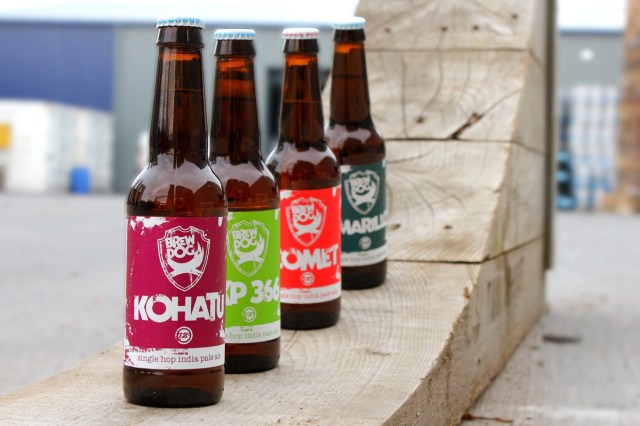
All four bottles in an arty-farty short

All four bottles in an arty-farty short

Anyway, this time Billy helped out and we ordered a couple bottles into London, from which he sent them through to Amsterdam. It’s funny that that is still cheaper than ordering directly from the brewery. What’s also pretty annoying is that the prices in Scotland are also higher than they are in Holland, for some reason. Luckily for BrewDog, they have some stuff we can’t get anywhere else.

The hops this year were Kohatu, Amarillo, Exp 366 and Comet. Kohatu, as you might expect from such a Maori sounding name is from New-Zealand. Amarillo is one of the best known American hops. Exp 366 is a new, not yet properly named hop kind from the States too. Comet is a not often used American hop, but this version is a German interpretation.

Exp 366
As good a brew as any to start this year’s experiments (pun intended). It’s a rather timid hop kind, with a bit of a malty nose. Slightly crisp and sweet. The palate has some creamy vanilla but still crisp. No spices, not very deep but pretty okay. Nice, but no cigar.

Comet
Dryer and less sweet than the Exp 366. Quite a bit of barley but still crisp. That’s the nose. The palate then, that’s dry, malty and dusty. More beery, more grassy and some cylantro.

Amarillo
This is the most American on the nose. Not sure how to describe it better, but there is definetly a typical style to it. Very crisp and almost crunchy. Some spiciness too. The palate is malty , rich and almost potato crisp like. Apple and rosemary.

Kohatu
My favourite of the bunch. This hop gives a very crisp and fruity nose. Quite some passion fruit like scents, which makes me remember the Trashy Blonde in a good way. It has quite some acidity because of it, but in a very good way. The palate has a lot of fruit too, but not in a very citrusy way. Much more apples and passion fruit. Star fruit, the potato crisps too, and maybe even a bit mineraly.

A very nice set, and the only complaint I can think of is that it misses the more typical European style of hop, like Goldings or so. On the other hand, I prefer the American style most of the time because of the added bitterness. European hops are generally a bit more sweet and less bitter.

The Kohatu is a pretty kick-ass beer and has a lot of flavours to discover. The added fruitiness was a nice surprise, since that usually comes as citrus and that was different in this case.

I wouldn’t mind getting a six-pack or a full case of it, but I guess that’s not going to happen. Ah well, I’ll drink the Punk IPA just as well.

So, thanks again BrewDog for doing this. I love the series, and I hope you can keep it interesting for a few more years. Now, if you’d only do something about the ridiculous shipping costs to mainland Europe, you’d rock even more!

Posted in - Beer | Tagged , , , , | Leave a comment