On the rare occasion that I host a whisky tasting for people that don’t already know a lot about whisky, I have my own way of approaching such an event. Whereas a lot of people do a ‘tour of Scotland’ by hitting all the regions I believe other parameters should be important instead of geography.
Especially since the world has changed over the last 20 or so years. When I started drinking whisky, you had fruity Speysiders, grassy Lowlanders, spicy Highlanders and smoky whisky from Islay. Campbeltown always the odd one out, in regional flavors that were categorizable in that way.
But, with Rosebank not being available the Lowlands got a bit thin in regards to their typical flavors. A lot of Speyside distilleries started creating smoky whiskies.
My approach is more centered at what you actually find on the label and how that translated to what you find in the bottle, and in your glass after that.
So, how does an 8 year old Glenfarclas compare to a 25 year old? How does a sherry cask matured Arran compared to a bourbon cask matured one? How does smoky whisky compared to unpeated whisky from the same distillery (hello again, BenRiach)?
When I hosted the first tasting at the job I currently have, this was exactly what I did. And therefor I can now review a Glenfarclas 25, since my ‘fee’ was to be able to take home what was left over. That sounded quite fair with about 22 people in the tasting. Unfortunately, in many case without notice, 13 people didn’t show up. And yes, this makes me reconsider hosting whisky tastings at work.
Image from Whiskybase
Sniff: Gentle with lots of dried fruit. Quite some oak and barley, so the cask wasn’t too overpowering. Some baking spices too. Very classical, very much a benchmark.
Sip: It’s surprisingly syrupy for a not cask strength whisky. A little bit of bite, and a bit more dryness than I expected. Sawdust, grist, oak and barley. Some dried fruits, peaches and apricots. A hint of powdery baking spices.
Swallow: The finish is, not entirely surprising, very similar to the palate. There is a note of lemon that I didn’t get before.
This is one of those whiskies that is a benchmark. Not because it sets the bar spectacularly high or so, but because it is a very solid whisky without any gimmicks. There is nothing that feels out of place and is more or less an indication of what a 25 year old single malt should taste like, at least.
Glenfarclas did what they do best with this one. Giving us a friendly, accessible whisky that is well made and well matured in quality casks. As always I quite enjoyed drinking this, even though the price has more than doubled in the last decade or so.
In 2021 I found a guy on the internet that was selling sample sets of Talisker 10. Nothing too spectacular, except for the wide range of vintages he was selling them from. Of course I got a set, and then never took the time to sit down for the whiskies until very recently.
What’s interesting about Talisker, apart from being a cool distillery in an even cooler location, is that the consensus among whisky geeks is that their outturn is rather inconsistent. Some batches are very good, some are bad, but in the end they seem to be unpredictable and have a huge bandwidth in which they release stuff.
I’m not sure whether that’s the quality of the whisky itself over the years, or that they have an inconsistent blending team or what is happening. What I do know is that before you buy a Talisker 18, you ought to try it. The same goes for Talisker 10, but luckily, these are a lot more affordable than the 18.
Anyway, Talisker 10 then. From a long time ago to very recently. Let’s go!
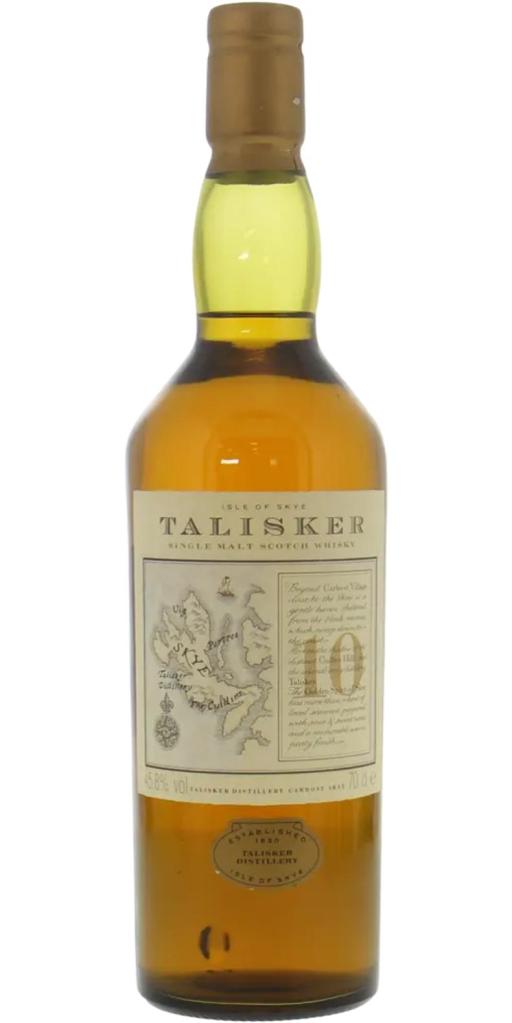
Talisker 10, bottled in 1998, 45.8%
Image from Whiskybase
Sniff: A surprisingly heavy nose with smoky diesel notes, barley and peat. A bit earthy, and very different to the newer batches. Slightly yeasty with oak and a little bit of vanilla. It does get a little bit lighter after a few minutes.
Sip: The palate is very oily and quite rich. The typical bite of black pepper is present too, with a bit of banana and baked apple. There’s not too much smoke, but the smoke that is there is far richer than any contemporary smokiness.
Swallow: The finish is rich again, with pepper and diesely smoke. It gets a little bit more dry towards the end and there’s a syrupy sweetness going on with hints of banana and soil.
Surprisingly rich, complex and un-coastal. This is really an old fashioned dram. A lot of flavors are showing up that don’t seem to exist anymore in contemporary whiskies, and I love it for it. Absolutely gorgeous.
90/100
Note: As suggested by a friend, this is most likely not the correct bottle. I do believe the whisky statistics are correct, but it would have been a green bottle at 75cl instead of a clear on at 70cl.
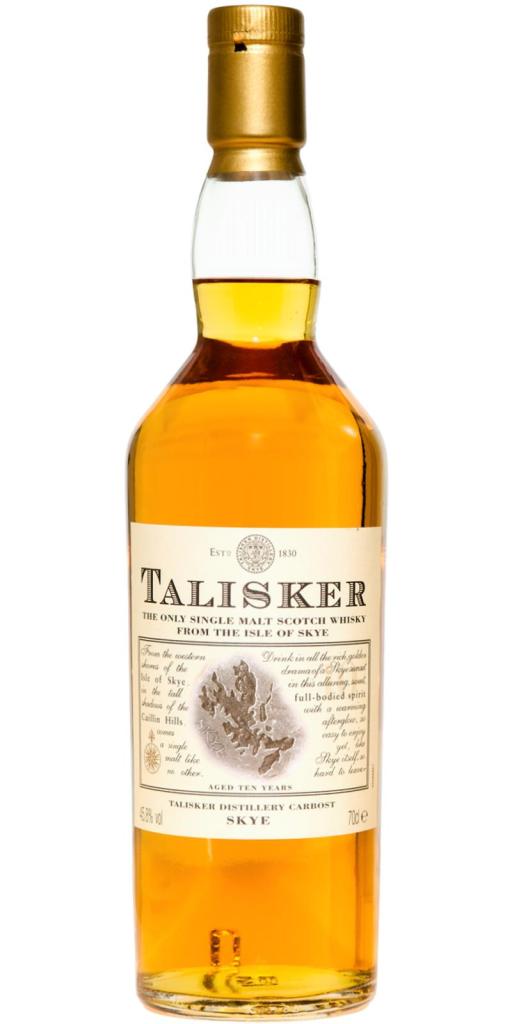
Talisker 10, bottled in 2004, 45.8%
Image from Whiskybase
Sniff: Compared to the 1988 it is a far more straight forward whisky. There’s some smoke, but it’s not very pronounced and has more of a coastal note than what came before. A little bit more vanilla, but still it’s very timid. All notes are a bit toned down.
Sip: Lots of pepper on the palate, and a very timid smokiness. The smoke does get a bit more oomph after a few seconds. There’s dry oak, a bit of a fruity syrupy note with a hint of unripe banana.
Swallow: A not very long finish, but one that showcases the flavors that came before again, albeit more gently. More coastal than before.
This is a whisky that already feels a lot more ‘directed’ compared to the previous one. That 1988 bottling felt more like it was happenstance to turn out like this. This is way more modern and guided to a desired flavor profile. Still quite good, with a lot of flavors to be uncovered, for such an ‘entry level dram’.
87/100
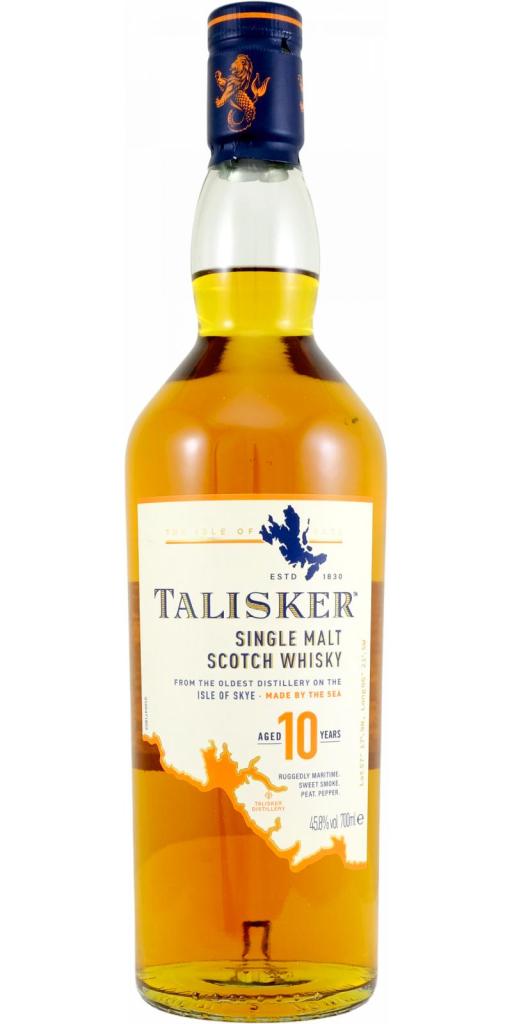
Talisker 10, bottled in 2016, 45.8%
Image from Whiskybase
Sniff: Suddenly, we’ve leapt into a different whisky all together. While still slightly smoky it focuses much more on the coastal notes, but also smells surprisingly chemical. There’s not a lot of pepper and quite a bit of wine gummy sweetness.
Sip: The palate is peppery again, as you would expect from Talisker. It’s quite a biter, surprisingly. Vanilla, oak, some barley. Of course, the expected whiff of smoke too.
Swallow: The finish shows mostly pepper and a little bit of smoke. The drying notes of barley and straw are suppressed by those two flavors.
While the coastal re-focus is interesting, the chemical notes put me off a bit. This is what I meant in the introduction about these bad batches. And no, it’s not ‘bad’, but it’s comparatively bad. As in, I would be bummed out if I bought this bottle because I liked Talisker 10 a couple years before and expected the same level of quality.
All in all, a pretty decent dram, but nothing spectacular.
“Made by the Sea”. Maybe next time get a blender involved too…
82/100
Talisker 10, bottled in 2021, 45.8%
Image from Whiskybase
Sniff: The fourth Talisker 10 in a row is more robust again. The pepper is toned down a little bit, but there’s more oak and barley. Also, there’s far less sweetness, and a whiff of washed up wood and therefore slightly more coastal notes.
Sip: The palate is gentle, and is quite dry with oak, salinity and straw. The pepper does show up with a bit of a vengeance if you let it swim for a while.
Swallow: The finish has a linger flavor of black pepper with its bite. Quite a bit longer than the 2016 one.
Luckily we close out this session with an upward direction. This batch is a lot more impressive than the previous one. A lot less chemically sweet, which definitely makes it a better whisky in my book.
85/100
The results are quite obvious in my opinion. The only one that doesn’t really belong is the third one, the 2016 bottling. That still has some of the tell-tale flavors and aromas for Talisker, but there’s something weird happening that I don’t like. The other ones are quintessential whiskies of their respective time period, I think. As in, Talisker 10 has always been a good entry level whisky, and apart form a random worse batch, it’s still a fun dram to drink.
Unfortunately, those versions from decades ago, with 1970s distillate like the 1988 bottling obviously have, have become quite expensive. Although, I guess that dram is better than many a similarly priced dram that is a more recent release.
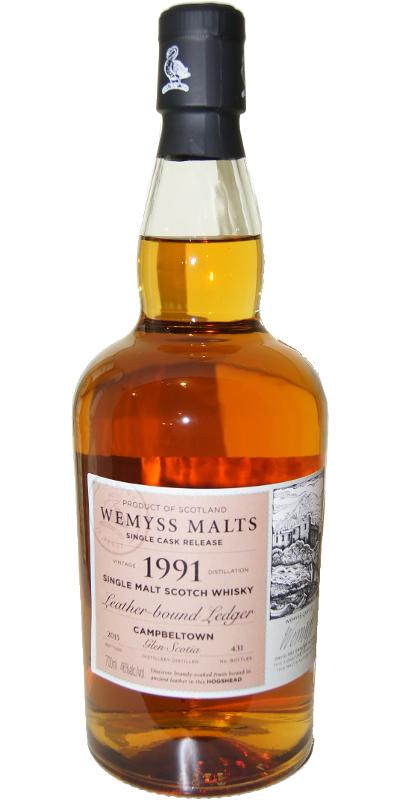
So, old books and cracker leather lay ahead of us, going by the title.
Wemyss is a bit of an oddball bottler in my book. Not in a very negative way, but I do think their blended malts get in the way of the single casks they release. It’s all nice to have a baseline of bottlings like Velvet Fig, Spice King and Smoky Shores, but I’ve never been swept away by these.
However, their single casks tend to be better than they get credit for. I have (and had) some Clynelishes, Glen Scotias and Bowmores in the past that were true stunners, but they barely show up on the radar. And when they do, they tend to not score incredibly well on Whiskybase. Strange.
Image from Whiskybase
Anyway, this one came from auction a year or two ago. Recently I’ve been in a ‘some bottles should be emptied’ mode and this one fell victim to that too. That’s when I get in a situation where I want to finish a bottle and pour it out, only to realize it’s a two-and-a-half dram instead of one-and-a-bit. Of course, that’s the stuff that happens when you think to have a nightcap before getting some Zs.
A great time to sit down quietly with the rest of the house being silent. A great time to do some reading, or (more likely due to tiredness) some Youtubing…
Sniff: Old books, yeasty sherry, barley and oak. There’s dried orange in the background. A whiff of hessian and some funky Glen Scotia notes. All are rather gentle, and restrained, in a good way.
Sip: A gentle palate, a dry note that wasn’t there before. Leather and old books. Yeasty sherry, the oloroso kind (as opposed to the sweeter styles). Quite a lot of flavours, with dried orange, old barley, oak.
Swallow: The finish keeps the dry note but loses the orange. A bit more one dimensional. Barley, funkiness, sherry.
Well, it lives up to its ‘Leather Bound Ledger’ name, so that’s something. With these whiskies I often realize it doesn’t have to be cask strength all the time. These 46% bottlings can be so gorgeous, and this one is no exception. Lovely sherry notes, a very old style of whisky, this!
Look at me reviewing a recent release of which I wasn’t sent a sample! That never happens!
Anyway, this one popped up a few weeks ago on the shelves of Dutch whisky shops. It stood out because it being a 13 year old whisky, at a reasonable price. Nowadays, whisky of this age from a somewhat special release generally clocks in at € 100 or more. This one didn’t. It still is widely available for under € 75!
Then, a wine cask, you say? I generally don’t really go for those, although I feel I’ve been saying that often recently, which defeats the point a little bit. Now I know Arran has some experience with weird cask usage from the start of the distillery, and I do think wine casks usually work better with peated whisky.
Image from Whiskybase
So, reasonable price, decent age, limited release, interesting cask (when with peated whisky). Let’s go!
Sniff: There’s a combination of fruity cask influence, barley and wood, and a whiff of smoke going on. It seems like there’s a tightrope act going on with all flavors being equally present and balanced. After a little while there’s some dark chocolate being added to the red fruits and slightly funky wine cask.
Sip: The palate is very soft for a 56% whisky, but there is some freshly cracked black pepper for a little bit of bite. The wine casks are present, but kept in check. Slightly funky with old, wet wood, straw and blue grapes jam.
Swallow: The finish leaves a bit of bite behind with black pepper and grape jam. There’s some straw and wet oak again.
A pretty present wine cask (like always), but the cask influence is really kept in check. Luckily, because the Arran style makes for a rather light whisky. In this case it works quite well and it’s an enjoyable dram. Especially if you realize this is available for an acceptable € 70!
So, if you can get this at MSRP, it’s quite good for what you pay for it. One of the better recent releases in regard to value for money.
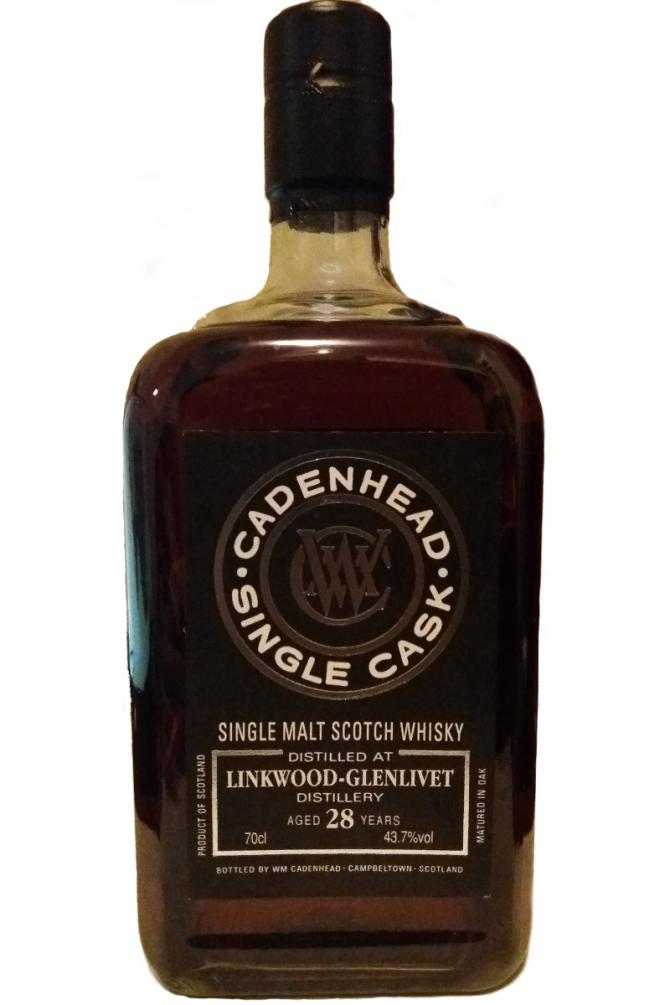
A quite rare bottle today! It’s a bottling from six-ish years ago and according to Whiskybase its price is still € 225, so I don’t think it has shown up on Whiskybase’s radar since it’s release years ago.
Even though it mentions that it’s sherry cask, that isn’t really necessary if you take one look at the color of this dram. Also, nosing or tasting kind of gives it away.
Generally I don’t really keep an eye on Linkwood. Of course I have had some good ones in the past, but I also had some real stinkers over the years. Even in our whisky tasting group there’s a running gag about a certain Linkwood by Liquid Sun.
A review then!
Image from Whiskybase
Sniff: Lots of sherry notes, in the GlenDronach way (at this moment of tasting I didn’t know what this is). Some baking spices, plums and dates, a hint of pastry with vanilla. Very 1970s in style, with the heavy notes of leather and syrupy sherry. There’s even a hint of aged balsamic vinegar.
Sip: The palate is surprisingly gentle, but that’s also because it’s a tad thin. I don’t expect this ABV to be too high, because I would expect a more dense whisky with that. There’s chili pepper after a little while, with dark dried fruits and a bit of a yeasty saltiness. It’s a bit of a sin to mention Christmas cake, but here we go. Contrary to what you’d expect, the thinness is gone after a little while of swimming.
Swallow: The finish is very consistent with the palate, but doesn’t have any of the wateriness or thinness that started of the palate. A long finish with lots of dried fruits and the first hint of straw and/or barley of this dram.
Lovely and old fashioned. There’s many layers to peel back, and with these heavily sherried drams that seems to be a thing of the past.
So, no bridge between weeks of reviews this time. Can’t think of anything that isn’t ridiculously far fetched.
This Octomore is peated to 139.6 ppm. If my information is correct, that the is the amount of phenols measured in the malted barley. This means that distillation still happens after measurement, as well as maturation, in which phenol levels always go down.
Still, a whisky is considered heavily peated when it’s around 40 to 50 ppm of phenol. Think Caol Ila, Lagavulin, Ardbeg and Laphroaig. I’ve once read that an average human nose can start picking up levels of smokiness in whisky when there’s about 3 ppm left in the final product. anCnoc releases the occasional peated whisky, on which they state the phenol levels of the distillate itself, and when they sit around 11 to 15, the whisky is considerably smoky.
What I’m trying to say in a very roundabout way is that peating something to 139.6ppm is kind of ridiculous. Generally I don’t care for Octomore. I’ve tried quite a few when they started to come out years ago, but it’s just not for me. The amount of smoke on the nose and palate obliterates all other flavors and aromas and the complexity is completely gone.
Also, there’s the inevitable discussion about price. Octomore comes with a hefty pricetag. Peating malt is an expensive process. Peating it to three times the level than regular heavily peated whisky is insanely expensive. And to end up with a drink that I don’t like means I don’t spend money on it. That is, once more in a roundabout way, saying that I got this sample from a friend.
Image from Whiskybase
Let’s dive in!
Sniff: Massively earthy and peaty. More like a highland peat style than I would’ve expected. Marram grass and straw, quite green and mossy.
Sip: A rapid build to insane bite and strength. The peat pushes back everything and even the smoky notes are suppressed or maybe just up to such a level that my palate shuts down. Green and young.
Swallow: Not a long finish, with some grassy, slightly coastal notes. Peaty, but not much else.
As said, all complexity is pushed to the back or completely gone. It’s quite a green whisky which isn’t strange considering what Islay peat is made of, and the youth of the whisky on top of it. Honestly, I don’t care for this. If you’re into smoky whisky and want to try the extremes, go for it. But if you prefer to be able to discern some flavors and have a contemplative dram, this one isn’t for you.
Of course, all personal preference aside. It’s not badly made or wrong. It doesn’t have any defects and it does exactly what it says on the tin. So there’s that.
Yeah, it’s one of those reviews where you see a good distillery, with a good vintage, from a good bottler. You know you’re in for a treat. Then again, that raises the bar at the same time, so us geeks tend to be more critical in such cases. At least, that’s my experience.
Ben Nevis is one of those distilleries that is high on my list for a visit, tour and tasting. But for some reason it has never fit the schedule, and therefore I have only driven past in on several occasions. I just happened to never stay in or near Fort William.
So, until then we just appease our curiosity by trying to drink some of their more incredible vintages. Like 1996. But, even their regular 10 year old is out of this world. Interestingly, we might add, because when I started drinking whisky little under 20 years ago, Ben Nevis was not seen as a very good distillery indeed. Most of their bottlings were only so-so, independent casks existed but weren’t overly popular too. It’s strange how things rapidly can change!
This one then!
Sniff: Yellow fruit galore! A complete fruit salad, the canned kind, in a trifle. So some boozy sponge cake too. There are quite some dry spices too, but not the heavy, baking spices. Dried ginger powder, unripe banana peels, peardrops, ‘Napoleon’.
Sip: The palate is slightly woody with dried ginger again. Dry spices, white pepper, oak shavings. Napoleon and peardrops. The sweetness that I expected on the nose is nowhere to be found. Dried coconut and a bit of beeswax.
Swallow: The finish is still bone dry and keeps the white pepper and dried ginger, and lots of yellow fruit. Apples, Napoleon, dried coconut.
This is a glorious whisky indeed. It does everything you hope a 1996 Ben Nevis does. Lots of fruitiness, but not too much sweetness, a properly matured whisky. I love that the ABV is slightly lower as well, so all the fruity flavors aren’t overpowered by too much alcohol heat. Great stuff!
Glencadam is, to me at least, one of those distilleries that you’ve tried every now and then, but have never really focused on in one way or another. As in, years ago I tried their official 15 year old and loved it. But after the tasting where I had, I completely forgot about the brand.
When it pops up in newsletters it doesn’t ‘spark joy’ immediately. Mostly because I don’t really have any expectation of the whisky. It could go either way. It could be very spirity or very cask driven. It could be harsh or it could be rather gentle. Many layers of flavor to be peeled back? Who knows?
So, when MZ was selling a sizeable chunk of his collection a year or two ago, and I saw this one in the list, I decided to get my hands on a bottle. It was in the middle of lockdowns, so I could immediately sell a part of it in the ‘Stay the Fuck at Home’ tastings I was hosting.
Image from Whiskybase
Interestingly, now I check the Whiskybase page I see the reviews being all over the place. Some friends of mine score it 86 or 87, but also 82 and 83. Of course, on a hundred point scale that is not the biggest difference, but if we keep in mind that 95-ish% of whisky falls in the 80-89 range, that is very significant.
Sniff: If you consider that single malt whisky is made from barley, and matured in oak, then this one does just that. There is a lot of barley and oak on the nose, and a lot of straw (so, barley stalks) too. But that’s it.
Sip: The palate continues much down the same line, but there’s a bit more sweetness to it. Lots of barley and straw, a rather hot oaky dryness too. There’s a bit of pastry flavor to it, puff pastry I’d say, with almond shavings.
Swallow: The finish is quite long and warming. The puff pastry note continues, as do the barley notes.
The strange thing is that there is almost nothing to discover, or at least I didn’t find it. However, the focus on barley and oak isn’t necessarily bad. It’s very pure and clean, but it lacks in depth and complexity.
According to Whiskybase this one now should go for little under € 200, and that is way too much for a whisky like this.
I guess I must admit, at least to myself, that I am an Ardmore fan. Over the last couple of years, I’ve gone through quite a few bottles and even when I don’t buy anything for a little while I have a hard time holding back when a new independent release comes by.
The lightly peated Highland whisky just ticks my boxes. It tends to have a dry and malty character, with a bit of smoke. I like that it’s the heathery non-Islay smoke too. Unfortunately, I’ve never visited the place yet, but I guess that is something that can be remedied at some point in time.
So, a sample of this came by somewhere. I don’t remember where since it has been some time since I tried it, and even longer since I got it. However, it’s likely that someone from my bottle sharing club had it available a year or two ago.
Sniff: Light on the nose, with some ashy scents. A light aroma of barley, some coastal salinity, and a hint of vanilla. An earthy smokiness, but not too intense.
Sip: The palate is quite hot with white pepper and chilli pepper. A lot of light flavors of oak, barley, smoke, marram grass, dry soil, peat, straw.
Swallow: The finish is a tad richer with some note of vanilla that wasn’t there before. The heat is toned down, but otherwise the finish shows the same notes as the palate did.
It’s interesting that barley seems to lose some richness when it gets smoked. At least, when Ardmore or distilleries like Highland Park are concerned. Having said that, I do like that far dryer character that is achieved by that.
This one is a fairly classic Ardmore, although the palate was surprisingly hot for the ABV and the age of the whisky. That does hold it down in regard to my rating, but it’s still quite nice.
A friend of mine gave me a sample of this a little while ago. Last year he visited the distillery on a family holiday to Scotland, if I recall correctly. This cask was available and although it officially doesn’t have too much information on it, except age and ABV, according to people at the distillery the cask used to contain red wine before it was used at this southern Highland distillery.
Generally, this is kind of a no-go for me, but something about a gift horse. Also, with him having tasted a couple of thousand of whiskies, and stating it is quite good, I’m willing to go into the unknown.
Image from Whiskybase
Sniff: A very rich and heavy nose with lots of wet, dark oak. From the get-go it’s clear some grape-alcohol hold sway here. Initially I was in doubt between Port and red wine, but it lacks the more earthy, woody notes of port casks. Some dried fruit like raisins and dates. A bit of rancio too.
Sip: Quite a sharp palate, with far more heat than I expected (I just had a dram at the exact samd ABV and this tastes like it’s 10% stronger). Dark oak, raisins, blue grapes, oak and a touch of soil.
Swallow: The finish mellows quickly and shows a slight chocolate-like sweetness. Also, there’s clearly more wine on the finish, and it’s a bit lighter than the palate.
According to Whiskybase this used to go for £ 120, which I honestly find quite steep for any 13 year old whisky. I am not sure whether it was available to try before you buy at the distillery, but I doubt I would have gone for a 13 year old wine cask whisky at this price. However, after having tried it, it is quite a good whisky indeed!
I like that it shows the cask quite well, even though it hasn’t completely blown the whisky flavors away either. A well done wine maturation/finish.






 Malt Fascination