Based on the label I was going for ‘That Boutique-u Whisky Company’, and based on the Dornoch / Thompson brothers I was going for that. Neither seems to hold any water and this is categorized as a random bottler on Whiskybase. Luckily, there was a vintage and an ABV on the label of my sample bottle.
Anyway, Glen Ord. In Muir of Ord. A distillery I sort-of visited in 2013, but which I didn’t tour. They didn’t allow my then zero year old daughter inside in a carrier, and I didn’t want to make my family wait for an hour and a half. It’s not like there’s a lot of entertainment in the direct vicinity of the distillery and my wife didn’t have her drivers license yet.
Diageo runs the place, with a huge maltings on the same premises, malting barley for various distilleries. The whisky from the distillery isn’t as available as it should, at least not from the distillery itself. It’s bottled under the Singleton label and exported mainly to Asia. Both are a shame since the official Singleton releases aren’t as good as the distillery is capable of, and the popularity that should exist doesn’t happen since no one ever gets to try more than the occasional Glen Ord.
Image from Whiskybase
Let’s see where this one sits, because I do have some expectations.
Sniff: Very timid on the nose with some grass and, strangely, a whiff of leather. Some farmy notes in the background, even. With a minute or two in the glass more scents start to come up. Pears, apples, some earthy, decaying stuff too. A bit of a thick sweetness without it being like pastry or desserts.
Sip: The palate continues down the strangely sweet, earthy road. Some vanilla in the background, but it’s mostly grass and hay, farmy notes. Green oaky notes too with moss, soil and mulch. Surprisingly autumnal for a distillery that I normally associate with a more summery style of whisky.
Swallow: A rather long finish, with mostly the earhty notes that linger. Some sweetness, but less than before. A whiff of vanilla and straw.
Even though it’s not a very typical whisky for the distillery, it’s a rather gorgeous dram. A lot of things are happening and the notes of decaying stuff at a farm make for a far better drinking experience than the descriptors might suggest.
Of course this bottle is not really obtainable anymore, but it is a very good one.
I guess the ‘expensive rum bug’ has bitten me too. After Michiel Wigman’s Precious Moments, which I still need to review, there’s this oldie. From an undisclosed distillery on/in Jamaica, to the Wu Dram Clan.
On their Facebook page there’s a list of sellers who had this bottle available and before it properly hit the shelves there, most of the listed shops had a ‘SOLD OUT’ after their name. I guess I won’t make myself a liar if I say Wu Dram Clan is popular. Passie voor Whisky was on that list, of course.
For bottle-sharing purposes I got myself a bottle too, so I could at least get a proper taste of it, without having to shell out for the full monty. At least, that is how it turned out. I pre-ordered the bottle before I knew whether or not there would be any takers. These releases are a now-or-never type of thing, after all.
Image by Wu Dram Clan
Let’s dive in!
Sniff: Quite estery, with a lot of oak on the nose. Some slight funkiness is present too, with hints of hessian and a ‘burnt sugar’ style of caramel. It’s quite intense with a lot of different scents. Some green banana, star fruit, dragon fruit. Sugarcane, grass, green bamboo, even.
Sip: The palate is much more dry than I expected, with even a minty note behind all the chili heat. Even though it’s ‘only’ 50% it brings quite the punch. Different styles of wood, with oak and bamboo. A bit less fruity than on the nose, maybe. It has some sweetness, but it’s not a typically sweet rum. It’s too dry and too estery for that. Still some green banana and star fruit.
Swallow: The finish brings a little bit more sweetness, and moves on from the very dry palate. It’s back to the estery stuff, but suddenly the long time in oak brings a touch of vanilla. That vanilla, combined with the estery flavors, brings some creamy pastry cream. A bit of banana split, without ever being overly sweet.
This is gorgeous. It’s miraculously not-sweet and the surprising dryness on the palate is something I really enjoy. The slight funky notes on the nose, with the wood on the palate and the overall fruitiness is absolutely great.
In short, I’m sorry for everyone who missed out. This is quite the bottle.
I didn’t put the cask type in the title, since there has to be something left for the post itself too. This, apparently, is a mix of rye whisky and bordeaux casks, but there are also chinkapin oak casks in the mix.
I’m always a bit confused when these are mentioned in the same breath, since rye whisky and bordeaux only mention the previous contents of the casks, but they could be of any type of oak. While chinkapin is the specific type of oak used. It’s a bit like describing your recycling as ‘something that contained milk, something that contained juice, and a plastic jar’.
Anyway, enough with the nonsense, and back to what is actually important.
Raasay Distillery, on the Isle of Raasay, just to the east of Skye has been operational for a little while. This release came out this year, but it’s not the first whisky they’ve released. Of course, the inaugural edition went like crazy, but these bigger batches seem to be quite available.
Without ever taking any notes, I was able to try some of their spirits at a festival stand at the Hielander Whisky Festival through Chris Hoban (also of Edinburgh Whisky Blog, among other things). I was rather impressed, even though I had to switch from epic whiskies from the 1970s at Dutch Whisky Connection’s stand to a 1 year old spirit, but still.
Image from Whiskybase
Lastly, before we head into the tasting notes, let’s take a minute to appreciate how absolutely beautiful these bottles are!
Sniff: There’s quite some peat on this one, with not a lot of smoke. As in, there’s some smoke, but it’s mostly earthy notes. Rather heavy with hints of mulch, rotting leaves, soil. Straw with a hint of seaweed. Some coastal notes with a bit of dry oak.
Sip: The palate is dry and light. A bit thin even. Some coastal notes with salt and brine, sand. But also straw, and slightly less earthy than the nose was. Smoke and soil, but more towards the smoke than before.
Swallow: More smoke again, interestingly. Not very long, but the slight thin-ness of the palate doesn’t continue here. There’s some oak and straw, so it’s still pretty dry, smoke and earhty notes.
Pretty solid whisky, and it’s taking a slightly different approach compared to Talisker (and therefore Torabhaig). Pretty heavy/dark and not too young.
The only thing I’m not really sure about is the mix of casks used. With a whisky this young and this peated, it seems a bit of a waste of effort. Also, and that’s just my take on things, I’d rather get to know the spirit at this age, than know what the team can do with casks.
Somehow, I got samples of this from two people. Also, I only found out after reviewing both samples. Something about doing stuff semi-blind…
With semi-blind is that I just don’t pay too much attention before pouring a sample, apart from the type of spirit (rum or whisky, so to say) and the ABV. In that regard I go in at least a little unprepared, which makes for some interesting surprises.
This Tamosi rum is a blend of five different distilleries (Foursquare, Varela Hermanos, Hampden, Worthy Park and Clarendon) from three different countries (Barbados, Panama and Jamaica for the last three distilleries). The Foursquare rum is eight years old, the Varela Hermanos is 6 years old and the Jamaican are categorized as ‘unaged’.
After blending the spirit was filled into port casks for about eight months, and bottled at 55%. I doubt this is cask strength, since rum generally sits at a much higher ABV.
Tamosi, apparently, is a deity in some Carib religions of yonder year. I don’t really know the specifics.
Image from Slijterijk Zeewijck
Sniff: Golden syrup, molasses, caramel and red fruits. The port adds some sweetness on the nose, but not as much as I expected. It also adds an interesting scent red fruit on the nose. Sweet oak, mashed overripe strawberries.
Sip: The palate arrives with a punch. It’s pretty sharp with chili heat, dark caramel and dry oak. Some richer notes of stewed red fruits and damp earth. It stays sharp for a long time and becomes drier if you let it sit. Some golden syrup and molasses sweetness. Strangely, I also get a note of apple and iron.
Swallow: The finish shows the most ‘rummy’ side of this yet. More sugarcane and a bit of the ‘quality rum funkiness’ with a hint of cigars and hessian, together with some tropical fruit and golden syrup..
Interestingly, the combination of both rum and port doesn’t make this too sweet. As in, both things tend to be sweet, and I was a bit apprehensive on the sugary concoction this would turn out to be, but it’s not so bad at all.
I don’t think I’m convinced about rum and port casks, but the combination of aged and unaged rums is something quite interesting. It pushes back the woody flavors, but does keep some of the ‘aged rum funk’.
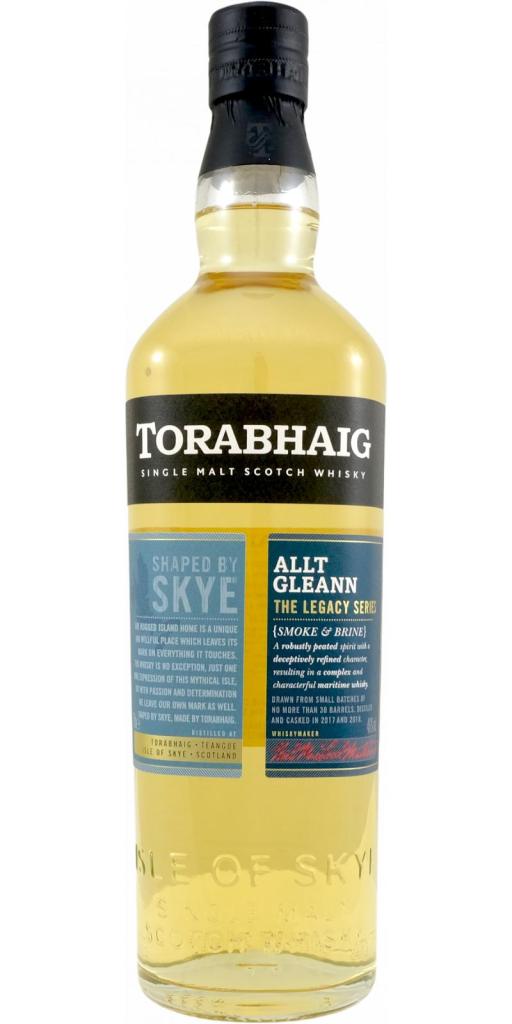
Torabhaig is the second distillery on Skye, after Talisker. As in, it’s not the second distillery ever, but it is currently. It’s been operational for a few years now and early this year the initial release came out, which I rather of liked.
It’s a dram that offers a similar character to Talisker, without tasting too young. I like Talisker, so that’s not a bad thing. And while it’s a rather solid dram, especially for something that’s just three years old, it also feels a little bit uninspired.
That sounds very negative, and it certainly isn’t positive. It’s not too bad either. It’s better to steal well than to invent bad, or something. What I mean by it is that they took the easy choice and copy a popular distillery’s style.
Still, a very solid dram, for a three year old. Especially at the price it went for.
Image from Whiskybase
Now there’s this one, which also uses refill bourbon casks and not just first fill ones like the inaugural release. Other than that, it should be rather similar.
Sniff: A spirity sweetness with hints of vanilla and grass. Marram grass, and a bit of a coastal smokiness. A light custard style sweetness, with a whiff of pepper and oak.
Sip: The palate brings the pepper to the frond, although it’s still rather sweet. Lots of vanilla and custard notes, with a bit of an apple crumble backdrop. Slightly green with notes of hay and grass. The salinity of the coastal note is present, but far to the back.
Swallow: The finish is different again. Not inconsistent, just different. Still rather sweet with lots of apple crumble and vanilla custard, but the pepper makes way for a more oak focused flavor.
Of course, I didn’t compare the whiskies since the first one is long gone. However, based on memory and tasting notes, I find this one a bit more sweet than the first. There are similarities, in the fact that it’s slightly smoky and rather coastal. That sweetness is something I don’t really like though. It’s easy and everyone’s friend, but it’s also not very idiosyncratic.
So, all in all, a nice dram and certainly not a bad one, but I do think they need to carve out their own niche a bit more, because the € 35 Talisker 10 trumps this € 60 Torabhaig.
Maltbarn is a bit of a blind-spot for me, in regards to bottlers. I know they are often well received, and are at the top end of what money buys in regards to value for money, if I’m not mistaken.
The problem with the brand, however, is that it’s only available at Whiskybase (AFAIK), and they often sell out before I’ve made up my mind about wanting a bottle or not. This Inchgower, though, came from an auction and was one of these random things that I put a fairly low bid on, but won anyway. It doesn’t happen often, but also not never.
Let’s see where this one ends up!
Sniff: A strangely dry type of sherry with quite some yeasty notes (nothing too strange, so far). There are also some rather grassy, and plant like notes. Spiced cake, almonds and raisin bread crust. Some burnt caramel, dates and figs too.
Sip: The palate brings some bite, but isn’t too strong. Some dried fruits like on the nose, and the slightly bitter note of almonds is there too. Strangely, there’s also a hint of moss and autumn leaves which I didn’t expect.
Swallow: The finish continues with the combination of almonds and raisinbread. Even slightly buttery, like almond paste. A little of the autumn leaves.
I’m not entirely sure where this one sits in regards to ‘typical’ Inchgower, but the sherry cask doesn’t feel too overpowering. It’s nicely fruity with some other notes of forests and caramel too. A good combination of flavors!
It’s available still, in the secondary market, but prices are getting rather high.
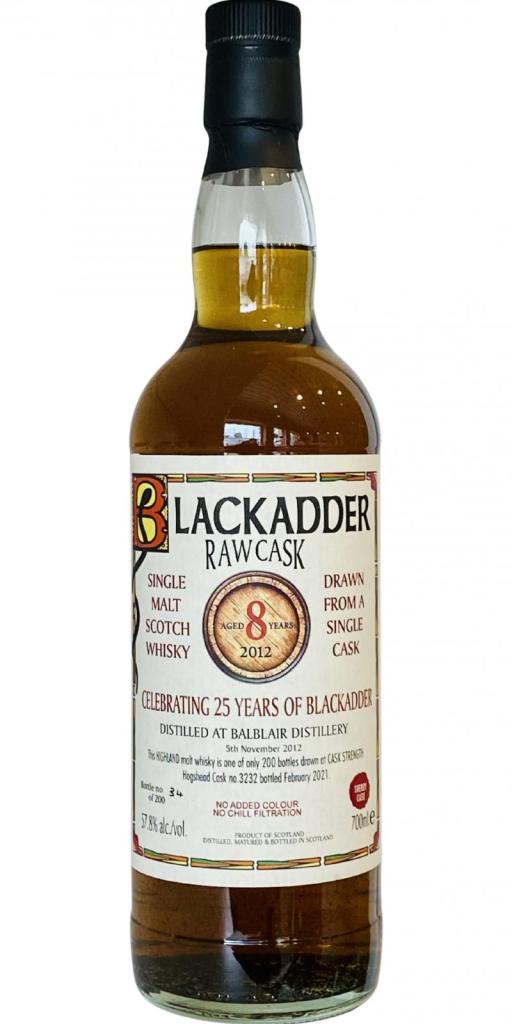
This is a bottle I recently used in a tasting. I got it based on the fact that it scores ridiculously high on Whiskybase, if you know where to look.
As it turns out, this is a split cask between Blackadder itself, used for the 25th anniversary of the brand. The other participant in the cask split is the ‘Southern Drammers Whisky Club‘ in Israel. The pure Blackadder one scores 87.18 (88 when I bought it, before the tasting), but the Israeli one scores over 90.
Of course, people tend to rate things they chose themselves higher. If it was my cask I might be more thrilled with it too. But anyway, an average of a high 88 for an 8 year old whisky by a brand that had slipped down my rankings over the years is interesting. Let’s investigate!
Image from Sieberts Whiskywelt in Munich
Sniff: Lots of sharpness and leather, charcoal. Very dark on the fruity side, so the raisins, the plums and the dates, all with seeds, stones and twigs for bitterness. Almond paste too. Far in the background there’s a whiff of chlorine or something chemical.
Sip: The palate still has a lot of sharpness and fierceness but there’s also a lovely sweetness. Not youth and pastry notes but more like candied pecans and dates. Even though it’s a sherry’d single malt, it’s not unlike some bourbons. Quite some oak, almonds, and no trace of that chemical stuff.
Swallow: The finish shows some more leather than the palate did, with hints of twigs and seeds. A long lasting flavor of dried fruits and spiced cake. Dried fruits, definitely sherry and deliciousness.
This whisky is ridiculously clunky, but it’s also very tasty. Clunky in the way that it’s far from smooth or gentle, or even comforting. This is a fight, in a way, but a good one. You’ll have to get over the initial blast of fierce leather and sherry.
I don’t think it’s good enough, or complex enough to warrant the 90 points, but I am on the fence between 87 and 88. I guess it all depends on what you’re looking for. When tasting this in a line-up it’s a fun and impressive dram. When settling down for the night with a book it’s too brash.
When lightly following The Bourbon Junkies on Youtube, you hear Kentucky Owl mentioned occasionally. Of course, that normally means that there’s something rather available in the USA that will never reach retail markets in Europe, unless you’re willing to shell out through all kinds of ‘investment’ websites.
That sort-of is true for these bottlings too. The ‘Confiscated 1916’ edition is available for prices of around € 125, which isn’t too bad. It’s also rather widely available, which makes ‘price obscurity’ less of a thing. As in, if it was just one shop, they could ask what they want, because you cannot compare prices…
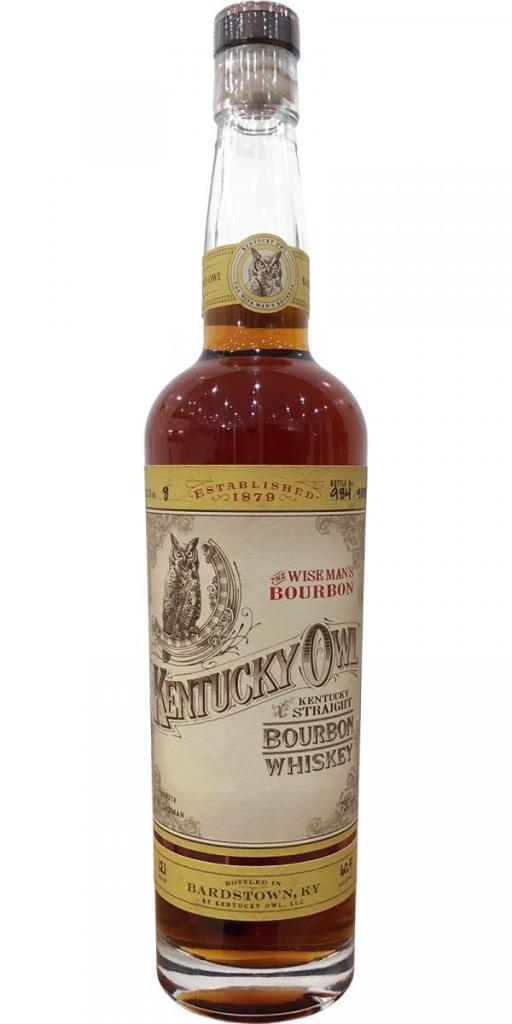
Kentucky Owl ‘The Wise Man’s Bourbon’ is quite a bit more rare in Europe. It’s available, but since it’s a bottling for the American market, prices have soared and this will set you back more than € 300. All availability is through ‘hard to find’ and ‘exclusive’ whisky shops. No surprise there.
Let’s just see where these bottlings sit, in regards to taste, then!
Kentucky Owl ‘Confiscated 1916’, 48.2%
Image from Whiskybase
Sniff: There’s a sweetness of corn spirit matured in fresh oak. Cigars, autumn leaves, some dried fruits like peach and dates. A whiff of wood smoke too. Dark cherries, with quite some dryness too.
Sip: Bitter orange at first, with quite some peppery heat. Lots of oak, dark chocolate, dark cherries, peach. The autumnal notes of fallen leaves is there too, and there’s a not of dark rye bread.
Swallow: The finish brings some more typical bourbon sweetness with lots of oak and barbecued apple. Brown sugar, cherry pie and tree bark.
Well, upon tasting this blind I would have guess this was a higher ABV, but all in all I find this is a very appealing bourbon. It’s quite complex and brings loads of different flavors to bear, without feeling unbalanced.
Sniff: Very stereotype on the nose, with lots of oak, lots of dry corn flour. Baking spices with a focus on a red cinnamon heat, and some dry ginger. Some cigars or even vanilla pipe tobacco.
Sip: The palate, when tried after some other cask strength whiskies, arrives deceptively gentle. After a few seconds, though, it starts kicking and screaming. It’s dry, it’s hot, it’s peppery. There’s chili peppers, red cinnamon, lots of fresh oak. Some corn flour, some red fruits in the background, with cherry stones, cigars and vanilla.
Swallow: The finish, again, starts deceptively gentle after you’ve worked your way through the palate. However, as before, the heat does come back. Not for too long though. The finish shows some heat with a hint of chocolate milk.
It’s very hot but there’s a lot of flavor to counteract that. However, behind that it’s a ‘very good bourbon’. In my book that makes it very drinkable, but not overly rememberable.
Last February I reviewed a Girvan, of which I had gotten a sample in Fiddlers’ Advent Calendar. Contrary to what I expected, I really loved it and even got myself a bottle.
Teun van Wel, of Maltstock fame, saw my ‘this is the exception to the rule’ style of post and must have have thought to change my beliefs.
Two very different angles of Teun thinking ‘this will not stand’.
Anyway, I reviewed them sometime during the summer holidays, and then completely forgot where I put the list. Luckily Teun kept a copy of what he sent, or else I wouldn’t have been able to make any sense of this post.
To whom it may concern:
Grain whisky is the style of whisky that makes up blended whiskies, together with malt whisky. Generally grain whisky is seen, and used, as a rather industrial product. It is produced in distilleries that look more like an oil refinery than what you’ve come to see as a distillery. Also, it is distilled to a much higher ABV (90+%) and needs much longer aging if you want it to be good as a single grain whisky.
Sniff: Not overly sweet and quite like a malt whisky, lots of grains, and a more dry oak than expected. Cherries and blackberries, dry wheat ears.
Sip: The palate is also very dry with white pepper, some red fruits although it’s slightly more bitter. Cherry stones, less ripe blackberries.
Swallow: The finish is largely similar, a bit more peppery and still very dry.
A tad simple, but rather tasty. It some how tastes like your ‘stroking’ an ear of wheat the wrong way. Of course it is not a grain whisky at all, but Teun snuck it in there anyway.
Sniff: Typical grain whisky with lots of sweetness, a whiff of glue, and wine gums. A lot of vanilla, wood and sap. A bit of maple syrup too.
Sip: The palate is quite fierce, with some alcohol heat that tastes like chili. Sweet, again, with grainy sugar, wine gums, and more chili pepper.
Swallow: The finish mellows quickly with the slightly biting dryness of the palate lingering the longest.
This is where we get into grain whisky territory, and this is generally why I dislike them. It’s all very sweet, and adding a sherry cask to something that I generally think too sweet already doesn’t work for me.
Sniff: Full on sweet wine gums and grain sugar. Pound cake, icing sugar, butter cream. Vanilla cheese cake.
Sip: Slightly dry and more grainy, white pepper and oak shavings. Still quite sweet but more cake like, instead of wine gums.
Swallow: The finish continues with the same flavors as the palate, although the sweet and the dry seem further apart.
Out of balance, and a tad inconsistent. Not bad, though. Interestingly, I had already tried this before and rated it quite a bit higher than I did this time around. Just goes to tell that (at least me) tasting whisky is very subjective. It does surprise me a bit though. Generally I’m a bit more consistent. Maybe too many variables changed? Setting, weather, ‘nasal conditioning’…
81/100
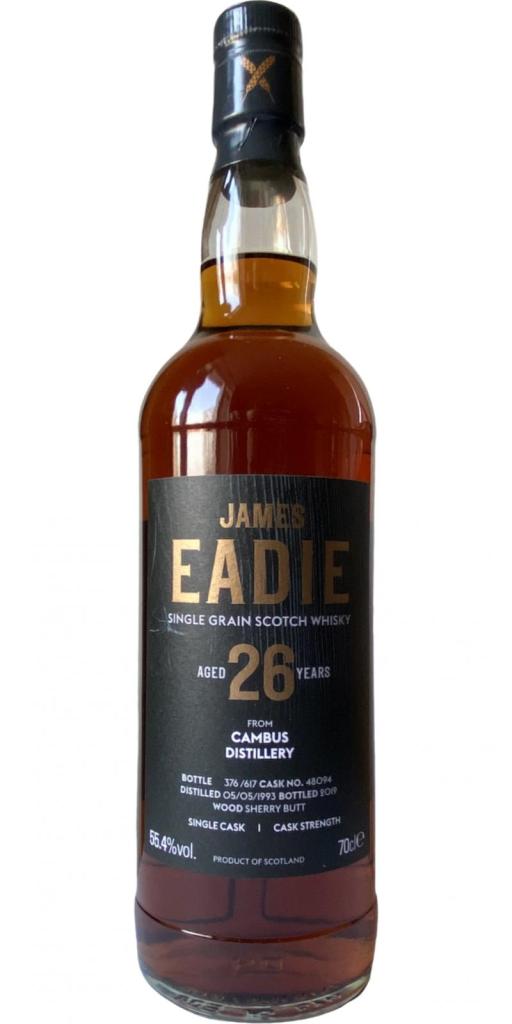
Cambus 26, 1993-2019, Sherry Butt 48094, 55.4% – James Eadie
Image from Whiskybase
Sniff: Massive hints of sherry, leathery with dried prunes. Lots of grainy sweetness, not surprisingly.
Sip: Quite smooth, with a bit of a bitter note. Prune stones, with dry oak. Dusty tree bark, the sweetness is still here, but overpowered by other flavors.
Swallow: Here the balance between bitterness and sweetness is restored. Still some leathery notes too, and more focus on the dried fruits.
This whisky from the last year the distillery was operational has a of sweetness, but in this case the sherry casks brings more bitterness, which I like.
Sniff: Vanilla ice cream and malt shake. It veers towards wine gums and peaches afterwards, but the vanilla stays.
Sip: The palate adds a peppery bite, not completely surprising. It stays with the vanilla sweetness, some caramel too. Malt shake again, maybe some root beer too.
Swallow: The finish is a lot sweeter again, some dry pepper and fresh tree bark. Vanilla, peach, caramel.
For a sherry cask, this had quite a lot of vanilla all the way through. The creaminess was also a bit surprising, but not completely unpleasant at all.
83/100
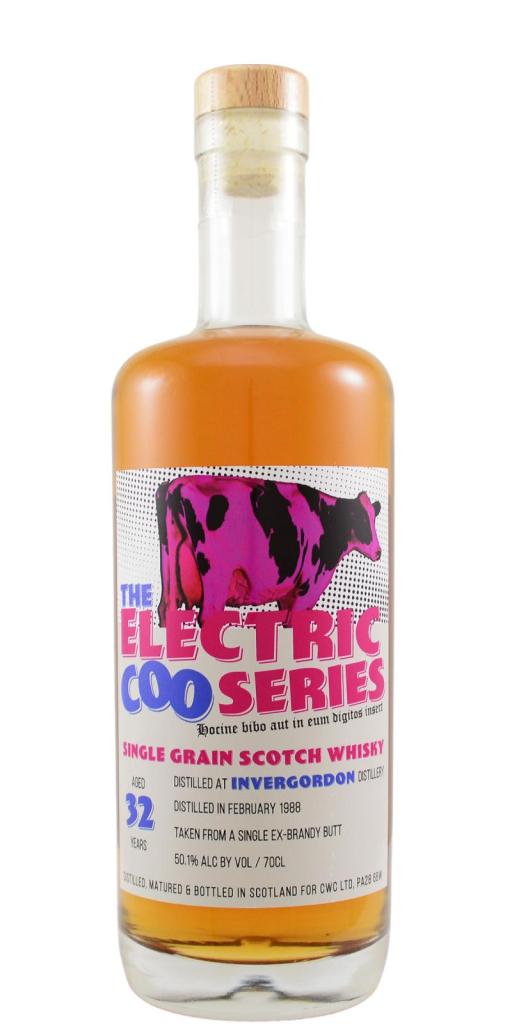
Invergordon 32, 1988-2020, Brandy Butt, 50.1% – Electric Coo Series
Image from Whiskybase
Sniff: This could very well be a wine cask. Red fruit, tannins, grape stems and seeds. Some thin milk chocolate notes too.
Sip: The palate is a tad flat at first, but some dryness and astringency builds up after a while. The flavors never get very pronounced though.
Swallow: More of the dryness follows, with a hint of rancio on the finish.
I have no idea what this is. And that’s the friendly way of putting this. A weird jumble of flavors without any balance. This is, I guess, where the brandy butt comes in. I had no idea what to make of this one but it tries to be everywhere at the same time. Not my cup of tea at all!
78/100
Let’s just say I’m not convinced. Some grain whiskies I don’t mind, some I do. Even fewer I really love, and it doesn’t all have to do with age, as we say with these early vintages here.
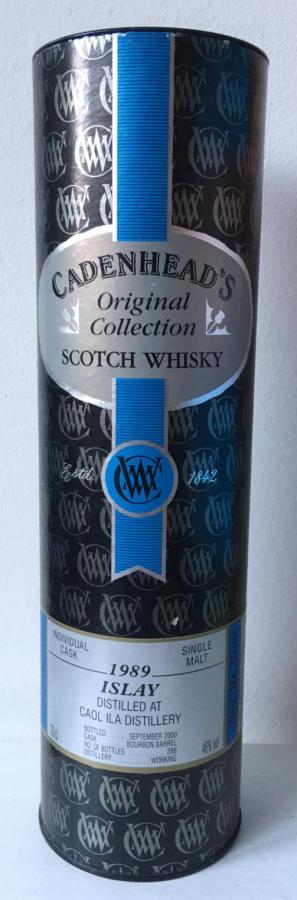
These Cadenhead bottlings are always interesting. Most of what I tried from this era was at cask strength, and they all shared a sort of ‘razor sharp’ profile, whether it was a Rosebank, a Bladnoch, or a Laphroaig. When I started being interested in whisky, I rather quickly realized Cadenhead’s bottlings weren’t for me.
Of course, when Mark Watt took over things picked up massively and they went from an often disregarded bottler (by me, that is), to the most interesting one based on quality and price.
Image by RvB
Interestingly, since Mark Watt left a couple of year ago, things have been far less interesting again. Of course, Brexit and the complete ridiculousness of getting bottles from the UK to the Netherlands didn’t help, but most of the releases that have been done since were far from enticing. Prices went up, ages went down, the ABV was often reduced to 46% instead of the natural cask strength that came before. And, also interestingly, it seemed the selection of distilleries to bottle casks from was focusing more on the lesser rated ones.
Then, RvB gave me a sample of this, which he used in a tasting that I couldn’t be part of because of shit planning on my side. A Caol Ila from an era that I generally quite like, and one that makes me ever so slightly nostalgic, since one of the first Islay bottlings I ever bought was of similar vintage and age. Let’s see where this one sits!
Sniff: A sweet peat that’s surprisingly earthy, for an Islay whisky. Some pastry notes with pie dough, and later on there’s a hint of seaweed and brine. Some salinity and charcoal as well.
Sip: The palate is warm and has some notes of salinity. IT’s soft and gentle, with brine, oak and quite some smoke. Vanilla and brioche buns.
Swallow: The smoke, brine and even a bit of fishiness round off this whisky. It’s less sweet than it was before, and more coastal.
When I drink a whisky that was bottled 20 years ago, I expect some form of ‘old bottle effect’ and this one is lacking that. Which, in result, makes it taste more like a contemporary bottling, since it doesn’t have much age either.
Having said that, it does feel like a rather generic Islay whisky. It has some sweetness and peat, and I would expect more notes of straw and grass from the region. It also doesn’t really show the typical Caol Ila notes of diesel and engine grease. A bit too clean to stand out, for me.







 Malt Fascination